




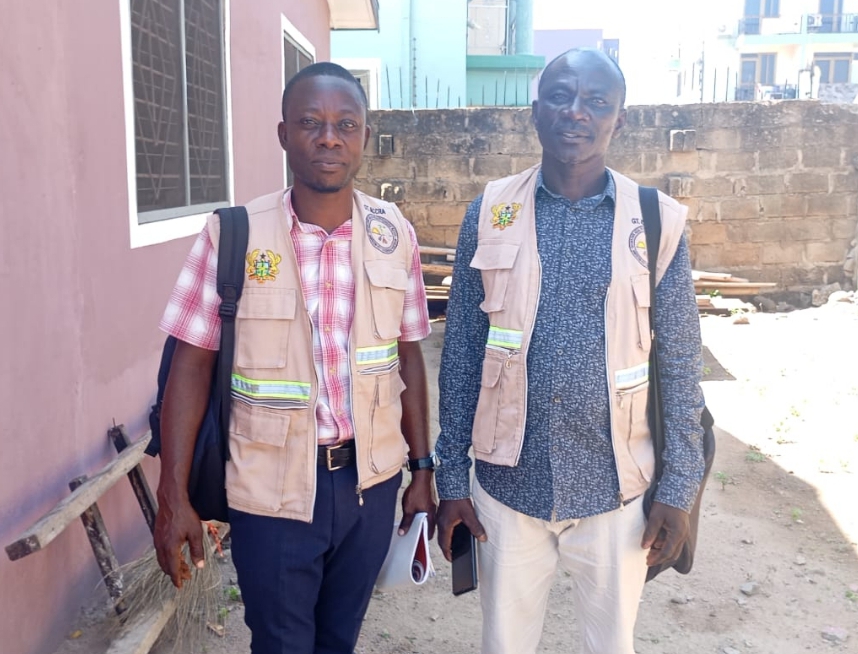
Environmental Health Officers from the Ga South Municipal Assembly are on the ground in the Kalabule community conducting a premises inspection exercise to ensure residents keep their surroundings clean and healthy.
The exercise, which forms part of the Assembly’s regular domiciliary inspection routine, is aimed at promoting sanitation and hygiene in homes, schools, churches, and other public places. The team, led by Mr. Charles Osei, an Environmental Health Officer, is visiting houses one after the other, interacting with residents and checking how refuse, wastewater, and toilet waste are managed.
Speaking during the inspection, Mr. Osei explained that their work focuses on the general condition of homes and the environment. “When we go for premises inspection, we look out for the general surroundings — how the place is kept, whether there is some growth of weeds or traces of reptiles, how we dispose of our refuse and our toilet facilities, how clean our houses are. We look at those things on our premises,” he said.
He added that the team does not limit its work to homes alone. “We visit schools, churches, wherever human beings are. We go there to ensure that sanitation and hygiene are maintained,” he said, noting that the exercise is done routinely based on a planned schedule.
“We have a plan of work where we normally go into the community,” he continued. “Today we are in the Kalabule area, tomorrow we will be going to Amanfro. Mostly, we get complaints. When we get complaints, we do follow-ups to make sure the problem is addressed.”
According to Mr. Osei, the team had already covered about eight houses by mid-morning. “So far, the main issue we have come across is the discharge of wastewater indiscriminately,” he said. “But we have been able to educate the households on how they can construct proper drains to manage their wastewater. The rest are minor sanitation issues which we have asked them to correct.”
He added that in some cases where the team observes serious problems such as overgrown weeds or full and overflowing septic tanks, they issue abatement notices. “You have to work on it within a specified time,” he explained. “If you refuse to carry out our instructions, then we will follow up and process you for court.”
Mr. Osei also spoke about the level of support the officers receive from the Assembly and the Ministry of Sanitation and Water Resources. “I will say almost 90 percent, we have it. The Assembly and the Ministry are resourcing us. Though we will not get it 100 percent, we hope to get all we need. Currently, we have enough resources to carry out our work,” he said.
He mentioned that the officers have been given the tools and logistics needed for the work, including motorbikes for community movement and inspection. He noted that these resources have made it easier to reach more areas and respond quickly to environmental concerns.
Mr. Osei used the opportunity to remind the public that environmental health officers, popularly known as “Sama Sama,” are still active in the communities. “We are in the community. Environmental officers, the Sama Sama, are there. It has not died; nobody has taken it out of the system,” he said. “We are just telling everybody to keep his or her premises neat. When we come, just cooperate with us.”

At the time of this report, the team was still moving from house to house within Kalabule, continuing their inspection and engaging residents on sanitation practices. Residents were highly commending the officers for their professionalism and the education they provided on environmental safety.
By Julius Blay JABS