





The Majority in Parliament has disclosed that the Ghana Cocoa Board (COCOBOD) requires a staggering GHS30.7 billion in working capital per annum to sustain operations, as the government rolls out comprehensive reforms to address the sector’s deep financial crisis .
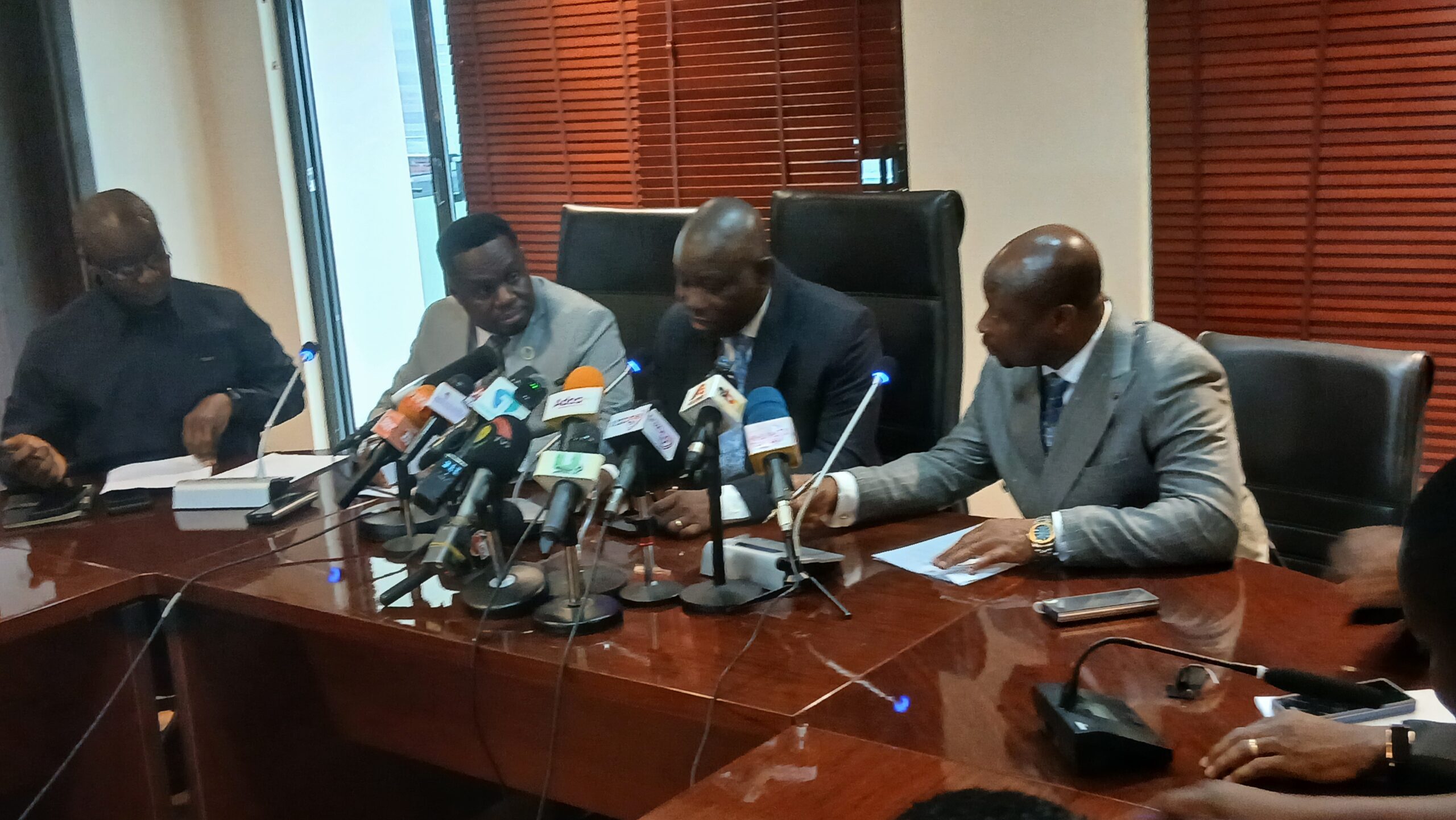
At a press conference addressed by Isaac Adongo, Chairman of Parliament’s Finance Committee, on Thursday, February 19, 2026, the Majority detailed the precarious state of the national cocoa sector and defended the government’s intervention strategy as the most viable path forward.
Adongo explained that the working capital requirement is based on a projected output of 650,000 tonnes, with costs from purchase to shipment estimated at GHS47,374 per tonne. This includes the current producer price of GHS41,392, buyers’ margin, and evacuation costs .
“The Majority in parliament has disclosed that the options taken by the government to deal with the current challenges in the cocoa sector is the best considering the huge debt in the sector,” Adongo stated, pushing back against Minority criticism .
A sector in distress: The scale of the crisis
According to the Majority’s briefing, COCOBOD entered 2025 with a cumulative debt of approximately GHS32.9 billion, alongside declining production, eroded equity, and loss-making financial statements that produced negative equity by Fiscal Year 2023 .
The financial distress was compounded by an unprecedented global cocoa price collapse of roughly 76 percent between January 2025 and February 2026 – a magnitude not observed in three decades .
In February 2026, the government initiated a comprehensive reset of Ghana’s cocoa sector aimed at restoring financial viability, rebuilding farmer confidence, and repositioning COCOBOD as a disciplined commercial institution capable of sustaining national output and value addition .
Forward sales debate and past over-commitments
Addressing criticisms regarding forward sales strategy, Adongo provided detailed figures to counter claims that the absence of forward sales caused the current crisis .
At the start of the 2025/26 season, COCOBOD had forward-sold approximately 530,000 tonnes – representing about 82 percent of the projected 650,000-tonne crop – at an achieved average FOB price near US$7,200 per tonne. Only 18–20 percent of projected sales remained exposed to spot-market prices during the subsequent global price collapse .
“Both forward and spot prices fell below US$6,000 at the trough, implying that even full forward coverage could not have sustained the earlier projected FOB level,” Adongo explained .
The Majority contrasted this with the 2023/24 season, which illustrated the risks of excessive forward commitments. During that period, 786,672 tonnes were contracted against an 850,000-tonne projection, but actual production was only 448,996 tonnes. This resulted in 333,767 tonnes of contracts being defaulted – approximately 42 percent – creating costly roll-overs that continued to burden COCOBOD’s finances through 2025 .
Legacy debt and government intervention

Breaking down the inherited financial burden, Adongo revealed that COCOBOD entered 2025 with roughly GHS17.8 billion in loans plus significant operational liabilities .
Current management has settled about GHS3.4 billion directly, while the government converted major obligations to equity, including Bank of Ghana and Ministry of Finance exposures. Outstanding liabilities now primarily include cocoa bonds and bills, AfDB facility obligations, cocoa roads commitments, and operational debts .
“These domestic and international shocks jointly necessitated structural reform,” Adongo emphasized, noting that there are no remaining syndicated-loan arrears, aside from a US$70 million bridge facility owed to the government .
A political dimension
The Majority also took aim at the Minority, suggesting their actions and inactions during their tenure in government contributed to the sector’s current challenges .
“Great leaders take bold, solid and decisive actions by introducing the needed reforms where necessary to foster an environment where accountability is a core value,” Adongo said. “This is exactly what Ghanaians expected when NPP collapsed COCOBOD during the heydays of H.E Nana Addo and Dr. Bawumia” .
As part of the ongoing reforms, COCOBOD has implemented internal cost-cutting measures, including salary reductions for executive management and senior staff, as the institution works to restore its financial health and secure the livelihoods of Ghana’s cocoa farmers .