








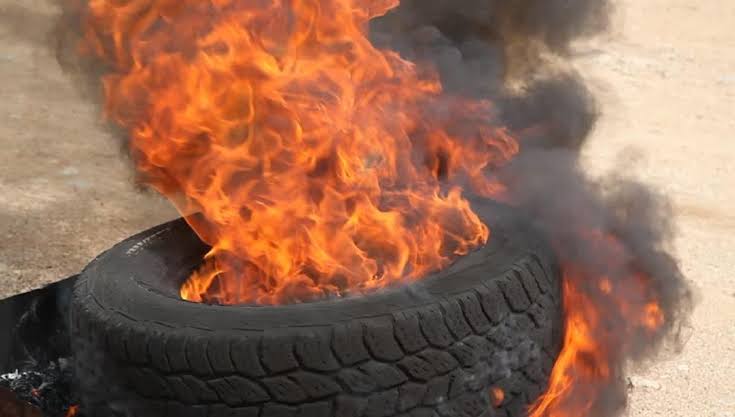
Across Ghana and other parts of Africa, dark smoke rising from slaughter sites has become a common sight.
Few, however, pause to think about what this smoke represents, the burning of lorry tyres to remove the fur of slaughtered animals. What many butchers consider a quick and efficient method has turned into a major threat to public health and environmental safety.
The use of lorry tyres in meat processing has spread because it is cheap and convenient. Firewood is becoming expensive and scarce, while discarded tyres are easily available and burn for long periods. This makes them seem useful for singeing hides. Yet behind this convenience lies a deadly environmental and health problem that is slowly poisoning workers, consumers, and the air we all breathe.
When tyres burn, they release toxic chemicals into the environment. Tyres are made from synthetic rubbers, petroleum products, heavy metals, and industrial additives such as zinc oxide, lead, cadmium, benzene, and carbon black. Once set on fire, they emit more than a hundred toxic substances, including polycyclic aromatic hydrocarbons (PAHs), dioxins, furans, and volatile organic compounds (VOCs).
The World Health Organization (WHO) and the U.S. Environmental Protection Agency (EPA) classify many of these as dangerous carcinogens.
Scientific studies show that burning just one car tyre releases over 2 kilograms of black carbon and 1.5 kilograms of toxic gases into the atmosphere.
The people most at risk are butchers and workers who stand near the burning tyres. The thick smoke irritates their eyes, throats, and lungs, often causing coughing, chest tightness, and difficulty breathing.
Long-term exposure leads to chronic bronchitis, asthma, and even lung cancer. A 2023 study in the Kumasi and Tamale abattoirs found that 68% of butchers exposed to tyre smoke suffered frequent respiratory issues, compared with 12% of those using LPG or firewood. The fine particles in tyre smoke, especially PM2.5, enter deep into the lungs and bloodstream. They carry heavy metals like lead and cadmium, which damage the brain, kidneys, and bones.
Consumers are also at risk.

The oily soot that covers the meat after tyre burning contains dangerous chemicals that cannot be removed by washing or cooking.
The Ghana Standards Authority (GSA) found that meat singed with tyres contains up to ten times more PAHs than the limits recommended by the European Food Safety Authority (EFSA). These toxins build up in the body and can cause cancers of the liver, colon, and stomach. The Ghana Health Service (GHS) has warned that regular consumption of such meat may damage vital organs, especially the liver and kidneys.
The dangers go even further. Lead and dioxins from tyre residues can harm children and pregnant women. In children, they affect brain development, reducing intelligence and causing learning problems. In pregnant women, exposure increases the risk of miscarriages, birth defects, and premature births.
According to the WHO, there is no safe level of lead exposure — even tiny amounts can cause irreversible harm.
Communities near slaughter sites also suffer from this pollution. Smoke from tyre burning settles on houses, markets, and farms. People breathe it in daily or ingest it indirectly through vegetables and water contaminated by soot and ash. The Environmental Protection Agency (EPA) of Ghana estimates that open tyre burning contributes to over 20% of urban black carbon emissions in cities like Accra and Kumasi.
This worsens air pollution and increases cases of asthma, heart disease, and premature deaths.
The overall effect is slow but destructive. Every exposure, whether by inhalation, contact, or consumption, introduces toxins that accumulate in the body over time.
These chemicals are persistent and nearly impossible to eliminate. Long-term effects include infertility, immune system weakness, and various cancers. What may look like an easy way to remove animal hair is, in reality, a serious public health hazard undermining the nation’s well-being.
In addition, this practice violates Ghana’s health and environmental laws. The EPA Act 490 of 1994 and the Public Health Act 851 of 2012 both prohibit open-air burning of harmful materials. Yet weak enforcement and lack of supervision at slaughter sites have allowed tyre burning to continue. Some butchers do so out of ignorance, while others lack safer alternatives.
However, safer methods are available. The Food Research Institute of Ghana reports that abattoirs using LPG gas burners or mechanized singeing systems reduced air pollution by over 90% and completely removed heavy metal contamination from meat samples. Smaller abattoirs can also use hot-water scalding and scraping, which are affordable and environmentally safe. These methods protect both workers and consumers while preserving the quality of the meat.
Therefore, government agencies such as the EPA, local assemblies, and veterinary departments must strengthen enforcement of environmental regulations. At the same time, they should educate butchers and support them with modern equipment and safer technologies.
Public awareness campaigns through radio, television, and social media are also essential to inform citizens about the dangers of tyre burning. Consumers can help by refusing to buy meat that smells of burnt rubber or appears dark and sooty.
In the end, the use of lorry tyres to burn the fur of slaughtered animals is not just an unhealthy practice but a silent poison. It destroys human health, pollutes the air, and contaminates the food chain. The black smoke that rises from our slaughter sites is not a sign of hard work — it is a warning that we are burning the very environment that sustains us.
By Curtice Dumevor, Public Health Expert