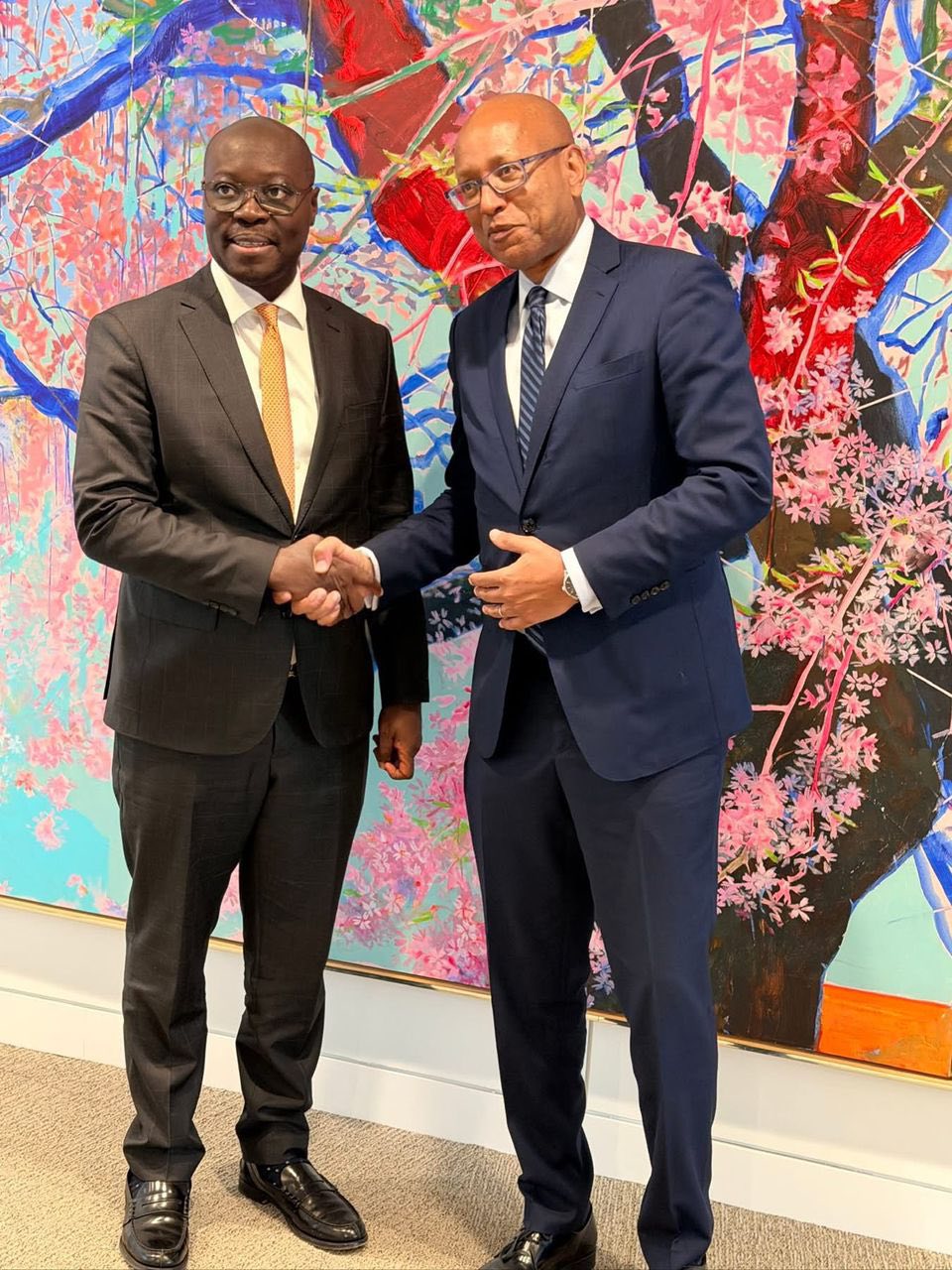








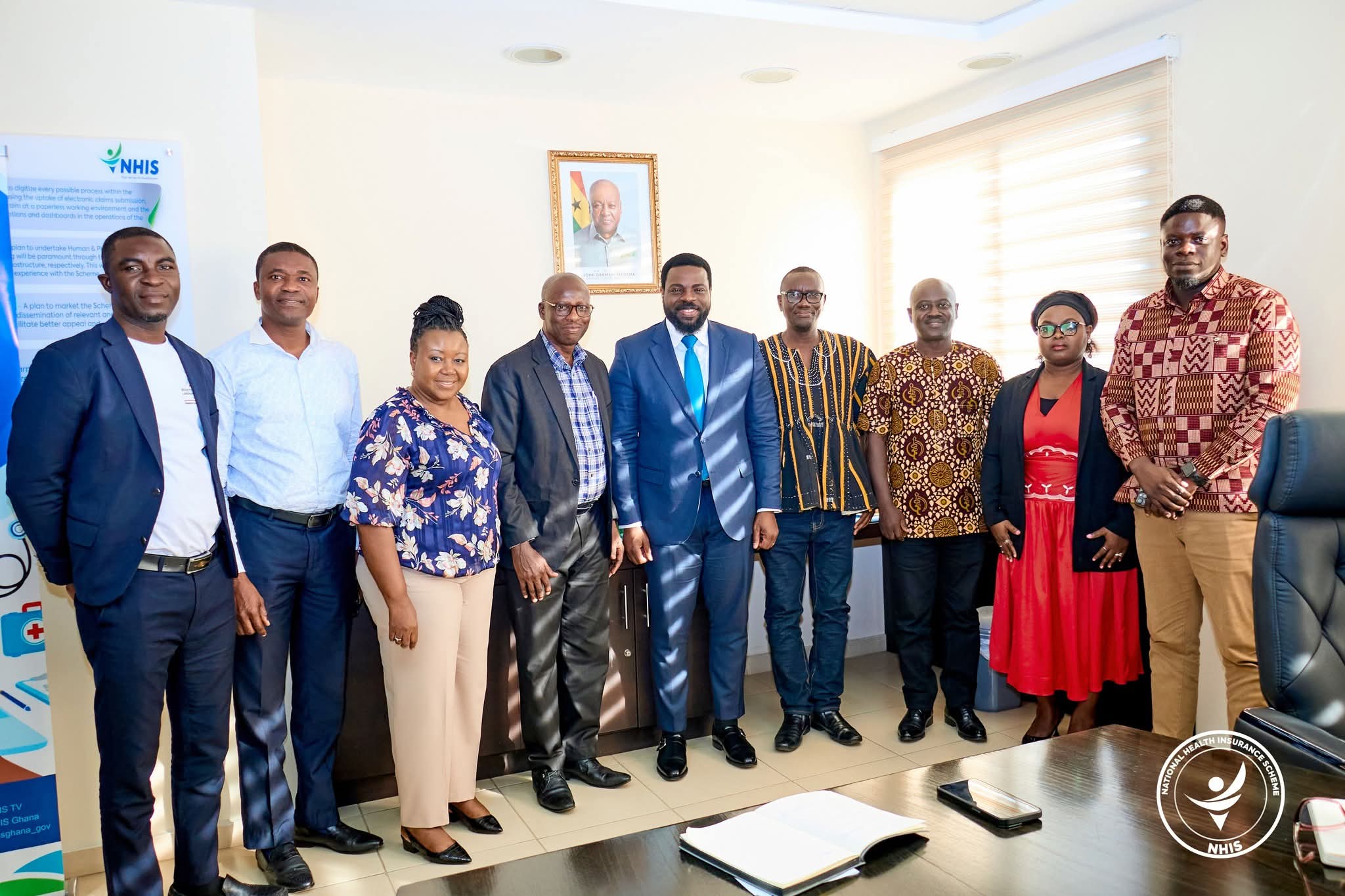
The National Health Insurance Authority (NHIA), Deputy Chief Executive of Operations, Dr. Senanu Kwesi Djokoto, in the Head Office held talks with leadership of the Society of Medical Laboratory Managers – Ghana (SMLM-Gh).
The delegation comprised the Society’s Board Chairman, Dr. David Sackey, Vice Chairman, Dr. Stephen J. Adusu, Financial Secretary, Dr. Pascal Hodogbe, Secretary, Dr. Nelson Ekow Kumah, and a member, Torgbi Dr. Adedze-Kpodo.
The engagement aimed to deepen collaboration with the NHIA and to advocate for fair tariffs, stakeholder inclusion, and clarity on the government’s proposed laboratory privatization policy.
Addressing their concerns, Dr. Djokoto acknowledged the Society’s pivotal role in the nation’s healthcare value chain and assured the Society of Executive Management’s determined synergy.
He explained that the National Health Insurance Scheme (NHIS) operates as a tax-funded social health insurance scheme, with over 95 percent of its funding coming from tax sources, including SSNIT contributions and a share of VAT.
“Premiums contribute less than five percent of our income. There are ongoing national discussions about whether premiums should be maintained, expanded, or scrapped entirely to ensure broader financial protection. Whatever path we take, we must avoid making premiums a barrier to access.”
On the issue of laboratory privatization, Dr. Djokoto explained that previous discussions on establishing regional centres of laboratory excellence were largely exploratory.
He said the initiative sought to leverage public-private partnerships by utilizing existing equipment and personnel. However, while the proposal was developed to an advanced stage, it was never finalized.
“Should the Minister revisit the matter, stakeholder input — especially from professionals like you — will be crucial to ensure outcomes that serve the best interests of both practitioners and the public,” he assured.
On tariffs, Dr. Djokoto revealed that the NHIA has completed a comprehensive review process aimed at ensuring realistic and evidence-based tariffs.
“We have moved away from across-board increases to a more scientific approach,” he explained. “This time, we looked at every service line by line, considering factors like electricity, water, maintenance, and staffing costs. The new tariffs will reflect actual operational realities.”
He added that the rollout of the new tariff structure, initially planned for mid-2025, was delayed to allow for budgetary, actuarial, and sustainability analyses, but assured that the implementation will take effect before January 2026.
“We will not enter 2026 with the old tariffs. Our goal is to ensure that providers are paid realistic rates while reducing out-of-pocket expenditure and advancing universal health coverage.”
Dr. Djokoto reaffirmed NHIA’s commitment to sustained dialogue and partnership with the Society, stressing that the NHIA values continuous stakeholder engagement as key to improving health service delivery nationwide.
The Society’s Board Chairman, Dr. David Sackey commended the new management of the NHIA for its proactive leadership and commitment to the timely reimbursement of claims.
He underscored the need to decouple laboratory revenue from general diagnostic services, explaining that the current boundary system, where laboratory finances are lumped together with other diagnostic services, makes accounting and revenue tracking for laboratories extremely difficult.
He noted that several attempts to decouple laboratory revenue from other services have proven futile and therefore appealed to the NHIA to consider alternative mechanisms that would allow laboratories to operate independently in their financial reporting.
Dr. Sackey also expressed concern about low tariffs for laboratory tests, explaining that NHIS reimbursements often fall below the actual cost of running the tests.
He further appealed for stronger collaboration between the NHIA and the Society to achieve Universal Health Coverage.
The Financial Secretary of the Society, Dr. Pascal Hodogbe, also highlighted the need for periodic review of NHIS premiums and tariffs, noting that their stagnation continues to affect healthcare facilities.
“The government’s reluctance to review premiums regularly has far-reaching effects,” he said, adding that “Low tariffs make it difficult for facilities to sustain diagnostic services, forcing some to charge patients directly.”

This situation, he said, undermines service quality and strains relations between professionals and management.
A member of the Society, Torgbi Dr. Adedze-Kpodo, expressed concern over the Health Minister’s recent comments on plans to privatize public laboratories, stating that such a move could negatively impact the profession.
“As professionals with the technical expertise, we believe privatization could derail progress in the sector. We urge government to engage all stakeholders before taking any final decision.”
Responding further, Acting Director of Quality Assurance, Dr. Lydia Anaab-Bisi clarified that the bundling of laboratory services within general tariffs did not originate from the NHIA but rather from broader health sector structures.
“If decoupling is to happen, it must begin from the Ghana Health Service. Nothing is impossible, but it requires alignment at all levels before the NHIA can implement it.”
For his part, the Acting Deputy Director of Credentialing, Mr. Eugene Segbefia, expressed appreciation for the visit and acknowledged the importance of including laboratory managers in NHIA stakeholder activities.
He encouraged the Society to support the NHIA’s National Electronic Health Service Application (NEHSA) and telehealth programme to enable the Authority integrate more laboratory data into the national health information system, enhance service coordination, and expand access to quality healthcare across the country.
“We are working on expanding the NEHSA platform, and we need more laboratories and diagnostic centres to join. Your Society can play a key role in advocating for your members to sign onto the scheme, as participation levels among labs remain low.”