








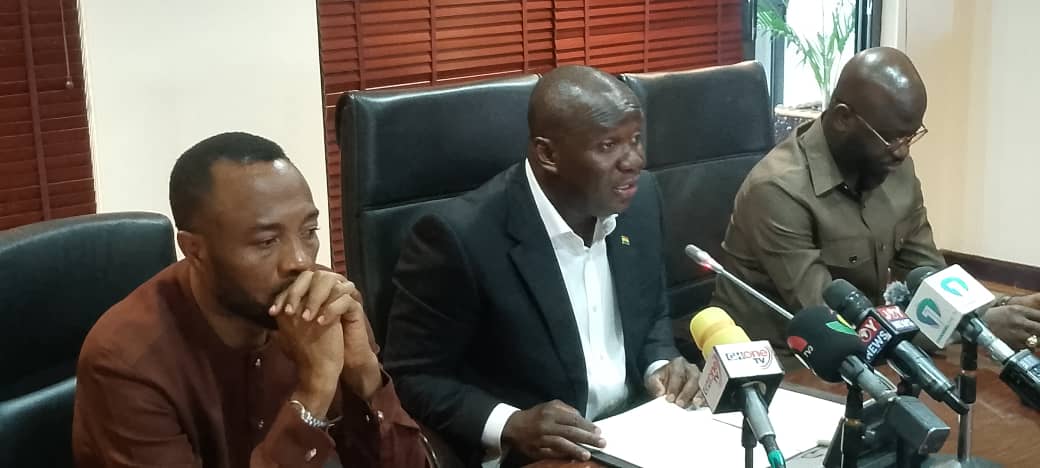
The Minority in Parliament, led by Member of Parliament for Damongo, Samuel Abu Jinapor, has submitted that “as Members of Parliament, we take this opportunity to reaffirm our commitment to defending the sovereignty of our nation, upholding the Constitution, and preserving Ghana’s hard-earned reputation as a principled and respected actor on the global stage”.
addressing journalists in parliament on the conduct of Ghana’s foreign affairs and recent changes in Ghana’s foreign policy posture, Mr. Jinapor said, “We have taken note of the comments by the Hon. Minister for Foreign Affairs, to the effect that the agreement with the United States is a Memorandum of Understanding, and would require Parliamentary approval only when it is “elevated” to the status of an agreement. The Minister further claimed that both the Hon. Attorney-General of Ghana and that of the United States have advised that the agreement does not need Parliamentary approval”.
He, however, called on the Government to exercise caution and consistency in articulating Ghana’s foreign policy positions, particularly on sensitive international conflicts such as the Gaza crisis, stressing the “the Government must ensure that Ghana’s positions reflect our long-standing commitment to non-alignment, multilateralism, and principled diplomacy, rather than hasty or unilateral declarations.”
Below is the full statement:
PRESS CONFERENCE BY THE MINORITY CAUCUS ON THE FOREIGN AFFAIRS COMMITTEE OF PARLIAMENT ON THE CONDUCT OF GHANA’S FOREIGN AFFAIRS AND RECENT CHANGES IN GHANA’S FOREIGN POLICY POSTURE
- INTRODUCTION

- Ladies and Gentlemen of the Press,
- We thank you, most sincerely, for responding to our call this afternoon.
- Today, we respectfully invited you to address some crucial matters in our country relating to the conduct of our foreign policy, including a flagrant disregard for our national Constitution, consistent breaches of our time-tested and cherished foreign policy, and continuous violations of the fundamental human rights, both of our nationals, and nationals of other African nations.
- These matters raise significant constitutional, legal, and policy questions that bear directly on Ghana’s sovereignty, international image, and diplomatic posture.
- We find it necessary to address these issues in the interest of safeguarding the integrity of Ghana’s constitutional order and protecting our nation’s long-standing reputation for principled, independent, and balanced foreign policy.
- We do this without malice or ill-will, but in faithful discharge of our constitutional duty to exercise oversight over the conduct of our nation’s foreign policy, and the management of our international relations.
- THE GHANA–US AGREEMENT ON THIRD-PARTY DEPORTEES
- Ladies and Gentlemen of the Press, the first issue we wish to address is the agreement between the Government of Ghana and the United States of America to receive into our country third-country nationals deported from the United States.
- You will recall that on Wednesday, 10th September, 2025, the President of the Republic, H.E. John Dramani Mahama, held his maiden media engagement in this second term of his presidency.
- At this media engagement, the President confirmed that Ghana has agreed with the United States to accept “third-party nationals who were being removed from the US.”
- This revelation came as a big surprise to the nation.
- Article 75 of our national Constitution is unequivocal on these matters. This article forms part of the set of provisions governing the role of the Executive arm of government in Ghana’s international relations. It provides that every treaty, agreement, or convention executed by or under the authority of the President must be laid before Parliament for ratification. The framers of our national Constitution considered this a safeguard against unilateral commitments that could affect the sovereignty, security, or international standing of Ghana.
- As far back as 2013, during the first term of this Government, the Supreme Court affirmed in the case of Republic v High Court (Commercial Division), Accra; ex parte, Attorney-General (NML Capital & Republic of Argentina-Interested Parties) [2013-2014] SCGLR 990 that any international treaty, agreement or convention that is not ratified by Parliament is of no binding effect in the Republic.
- It would be recalled that in 2016, this same Government, in flagrant disregard of the Constitution and the above Supreme Court decision, entered into an agreement with the United States to receive two inmates at the Guantanamo Bay into our country without the requisite parliamentary approval.
- In seeking to justify its unconstitutional action, the then Attorney-General argued that the agreement reached with the United States was not one contemplated under article 75 because it was not an agreement in “a solemn form” but one reached through “mere diplomatic notes.” The Attorney-General, therefore, urged the Supreme Court to make a distinction between “an agreement intended to create a legal liability and one which, although made between two state parties, is not intended to create legally binding obligations and rights.”
- The Supreme Court, in Banful v. Attorney-General [2017–2020] SCGLR 82, flatly rejected these arguments of the Attorney-General, holding that the Constitution makes no such formal distinction, and that every agreement made with another state, no matter the form, requires parliamentary approval. Specifically, the Court held that “where, by various forms of documentation, the Government of Ghana binds the Republic of Ghana to certain obligations in relation to another country or group of countries, an international agreement comes into existence.”
- Based on the above, the Court concluded as follows: “upon a true and proper interpretation of Article 75 of the 1992 Constitution of Ghana, the President of the Republic of Ghana, in agreeing to the transfer of Mahmud Umar Muhammad Bin Atef and Khalid Muhammad Salih Al-Dhuby to the Republic of Ghana, required the ratification by an Act of Parliament, or a resolution of Parliament supported by the votes of more than one-half of all the members of Parliament, and by virtue of the failure to obtain such ratification the agreement is unconstitutional.”
- It is, therefore, surprising that the current Government, which superintended over this unconstitutional acts which was pronounced upon by the Supreme Court would, once again, enter into a similar agreement with the same United States and proceed to receive foreign nationals into our country, pursuant to the said agreement, without regard to the clear constitutional requirement to seek parliamentary ratification.
- The fact that we the minority members on the Foreign Affairs Committee had to learn of this development in the media is very concerning, and is consistent with attempts by the Executive to disregard the other arms of Government.
- We have learnt that some of these foreign nationals are being held in detention centres against their wishes, and have gone ahead to institute legal action against Government for the breaches of their fundamental human rights.
- Despite these actions and genuine concerns being raised by the international media, we are told that some forty (40) more people are due to arrive in the country pursuant to this same unconstitutional agreement.
- We have taken note of the comments by the Hon. Minister for Foreign Affairs, to the effect that the agreement with the United States is a Memorandum of Understanding, and would require Parliamentary approval only when it is “elevated” to the status of an agreement. The Minister further claimed that both the Hon. Attorney-General of Ghana and that of the United States have advised that the agreement does not need Parliamentary approval.
- We wish to remind the Hon. Minister that the Constitution makes no distinction between formal agreements and Memorandum of Understanding. As held by the Supreme Court in the Banful case, the provision even covers agreements reached by Note Verbales. The attempts by the Minister to downplay this agreement in the face of this clear provision of the Constitution is very disturbing.
- Indeed, in the case of Brogya Gyamfi v. Attorney-General [2020] DLSC 8803, the Government of President Akufo-Addo, in consonance with article 75 of our Constitution, laid before Parliament a Defence Cooperation agreement with the United States for ratification, even though the said agreement had not been signed. The Supreme Court held that the then Government was right in laying the said agreement before Parliament, for even such unsigned agreements come under article 75 once Government seeks to implement same.
- It is therefore irrelevant whether the agreement is signed, or it is called an agreement or a Memorandum of Understanding, or it by exchange of Note Verbales, Parliamentary ratification is required for the implementation of any such arrangement.
- We are, also, shocked by claims of the Hon. Minister that the Attorney-General advised Cabinet that this agreement does not require Parliamentary approval. The Attorney-General of the Republic was the Deputy Attorney-General when the decision in the Banful case was delivered by the Supreme Court. He cannot feign ignorance about this case and purport to give a legal opinion which, therefore, contradicts the decision of the Supreme Court, if indeed he did.
- The opinion of the United States’ Attorney-General, if it was indeed given, is of no consequence in our country, as both the constitutional provision and the Supreme Court decision are very clear. Indeed, the Supreme Court held in the Banful case that the distinction in the United States between “executive agreements” which does not require the approval of Congress, and treaties which require such approval are not applicable in Ghana in light of the clear constitutional provision in article 75.
- The Government’s conduct in operationalizing the agreement with the United States without parliamentary ratification is a direct constitutional violation of Article 75 and an affront to the authority of the Supreme Court. It is therefore deeply concerning that the Government continues to operationalize the agreement with the United States despite this flagrant constitutional breaches. Such conduct reflects a lack of respect for the rule of law, which is one of the fundamental pillars of our constitutional democracy.
- Beyond this blatant constitutional breach, the agreement raises pressing concerns of sovereignty, security, and policy. While regional integration remains a core value of our foreign policy, it cannot be stretched to justify the forced reception of foreign nationals deported from other countries. The ECOWAS Protocol on Free Movement concerns voluntary travel, not forced deportations orchestrated by a non-ECOWAS State.
- On the international stage, the foreign policy consequences of this agreement are equally alarming. Ghana has, over decades, built a proud reputation for principled diplomacy rooted in non-alignment, regional solidarity, and respect for human rights. The decision to serve as a receiving point for West African deportees from the United States risks our country being perceived as aligning itself with the US Government’s current immigration enforcement regime, one which has been criticized as harsh and discriminatory. To associate Ghana with such policies could have several negative implications for our country.
- We therefore reiterate our call on the Government to suspend, with immediate effect, the unconstitutional implementation of this agreement until Parliament has duly exercised its constitutional mandate to ratify same. We further urge Government to provide full clarity on the processes, safeguards, and other broader implications associated with receiving these deportees, including the measures, if any, that have been taken to protect Ghana’s security interests.
III. GHANA’S FOREIGN POLICY AND THE GAZA CONFLICT
- Ladies and Gentlemen, we have also taken note of recent public pronouncements made by the Honourable Minister for Foreign Affairs on the ongoing conflict in the Gaza Strip. In those remarks, the Minister characterized the developments in Gaza as “genocide” and further indicated that Ghana has made clear its position in engagements with Israeli authorities, while also expressing solidarity with the Palestinian people, including through material support.
- While we recognize the need for Ghana to remain an active voice in the international community and to speak on matters implicating humanitarian concerns and respect for international law, we must emphasize the importance of consistency and balance in such pronouncements.
- Article 40 of our national Constitution provides broad principles to guide Ghana’s international relations. These include the promotion and protection of Ghana’s national interests, adherence to international law and treaty obligations, and the fostering of respect for international cooperation.
- Since independence, Ghana’s diplomacy under successive administrations has been guided by principles of non-alignment, mutual respect, and peaceful coexistence. This enduring posture has enabled successive governments to engage credibly with all sides in situations of conflict, while preserving Ghana’s role as a respected and impartial voice for peace, dialogue, and the rule of law.
- By describing the events in Gaza in absolute terms and aligning the country explicitly with one side in a highly polarized conflict, the Government risks compromising the delicate balance that has long safeguarded Ghana’s credibility as an impartial actor on the international stage.
- Our tradition has been to call for peace, dialogue, and adherence to international law, without issuing declarations that may prejudice our ability to play a mediating or bridge-building role. Successive governments have, over decades, interpreted and applied these principles by maintaining a posture of independence and impartiality in international conflicts.
- It is therefore crucial that in responding to the Gaza conflict, Ghana’s official statements continue this tradition: speaking clearly to the need for peace, the protection of civilians, and adherence to international law, but doing so in a manner that avoids the perception of taking sides in a deeply divisive conflict.
- The Minority Caucus wishes to emphasize that Ghana’s enduring strength in international relations has always come from its ability to maintain independence, neutrality, and credibility, even when global powers have sought to draw us into their competing blocs. Departures from this tradition, if not checked, could diminish our moral authority on the international stage and compromise our broader national interests.
- We call on the Government to exercise caution and consistency in articulating Ghana’s foreign policy positions, particularly on sensitive international conflicts such as the Gaza crisis. The Government must ensure that Ghana’s positions reflect our long-standing commitment to non-alignment, multilateralism, and principled diplomacy, rather than hasty or unilateral declarations.
- CONCLUSION
- As Members of Parliament, we take this opportunity to reaffirm our commitment to defending the sovereignty of our nation, upholding the Constitution, and preserving Ghana’s hard-earned reputation as a principled and respected actor on the global stage.