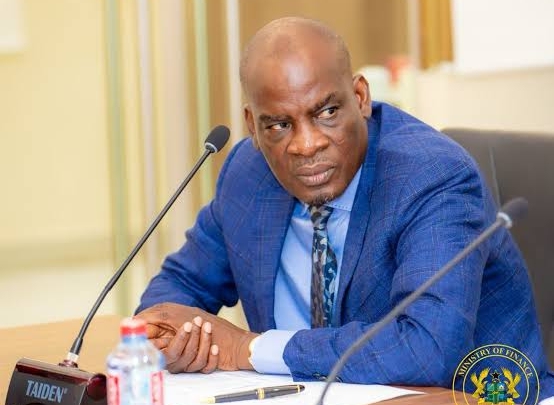









Minority Leader in Ghana’s Parliament Osahene Alexander Afenyo-Markin is facing contempt charges for allegedly defying a parliamentary resolution that removed him from Ghana’s delegation to the ECOWAS Parliament.
The Majority Leader, Mahama Ayariga, filed a complaint against Afenyo-Markin, citing his attendance at an ECOWAS Parliament session in Port Harcourt, Nigeria, despite being excluded from the delegation.
Accordingly, Speaker of the House Alban Bagbin, has referred the matter to the Privileges Committee for investigation, stating that Afenyo-Markin’s actions prima facie implicate the dignity and institutional integrity of Parliament.
If found guilty, Afenyo-Markin could face disciplinary action.
The Minority Leader has expressed readiness to face contempt charges, stating that he is prepared to go to prison for criticizing the judiciary.
This development is the latest escalation in tensions between the Majority and Minority leadership in Parliament.
In delivering his ruling, establishing a prima facie case of contempt against the Minority Leader, Alexander Kwamena Afenyo-Markin, concerning his attendance at the September 2025 ECOWAS Parliament sitting in Port Harcourt, Nigeria.
The Speaker referred the matter to the Privileges and Immunities Committee for full investigation.
The ruling follows a formal petition submitted by the Majority Leader, Mahama Ayariga, who alleged that the Minority Leader had defied a duly adopted parliamentary resolution that excluded him from Ghana’s official delegation to the regional legislature.
The complaint, filed on November 11, 2025, under Orders 6 and 33 of the Standing Orders, accuses Afenyo-Markin of an affront to the authority and dignity of Ghana’s Parliament by contravening the House’s resolution.
Contempt of Parliament
In his comprehensive ruling, Speaker Bagbin underscored the binding effect of a parliamentary resolution, stressing that once adopted, it becomes binding on all members, irrespective of political affiliation or leadership status.

He emphasized that neither the Speaker nor any individual member can unilaterally disregard a resolution passed by the House.
Addressing the scope of Parliament’s contempt jurisdiction, the Speaker clarified that it is not limited to acts committed within the physical chamber.
“The relevant test is whether the conduct has a direct or indirect tendency to obstruct, diminish, or bring Parliament into disrepute,” he stated.
While acknowledging that non-compliance with a resolution is not explicitly listed as a form of contempt, the Speaker invoked Section 26 of the Parliament Act, 1965 (Act 300), which makes clear that the enumerated grounds are not exhaustive.
After reviewing the complaint and applicable legal principles, Speaker Bagbin ruled, “I am satisfied that the matter raised prima facie implicates the dignity and institutional integrity of this House.”
Invoking Order 341, he then formally referred the case to the Privileges and Immunities Committee and issued specific instructions:
Ascertain the facts surrounding the complaint.
Review actions taken by both Parliament and the Minority Leader.
Examine the conduct within the framework of the Standing Orders and ECOWAS parliamentary protocols.
Determine whether contempt or breach of privilege has occurred.
Submit recommendations to the House for final consideration.
The Speaker, however, cautioned all members to refrain from public commentary on the matter to preserve the dignity and integrity of Parliament until the Committee