






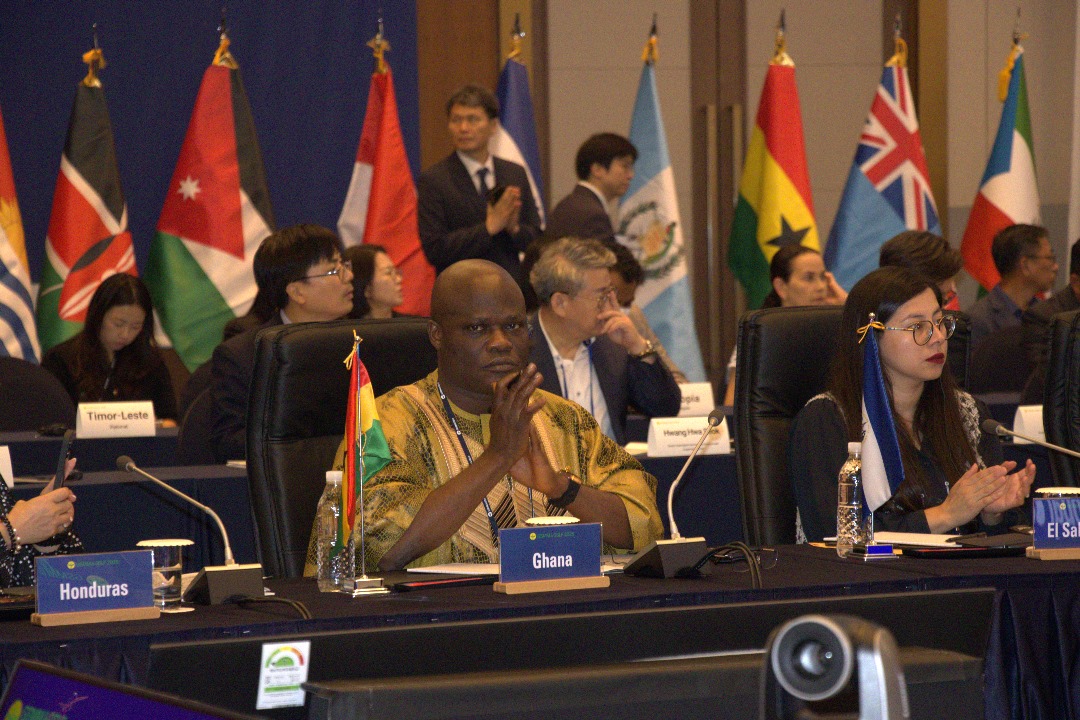
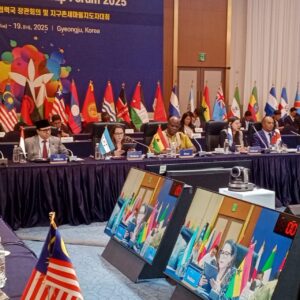
The Local Government, Chieftaincy and Religious Affairs Minister, Ahmed Ibrahim, is currently in Korea participating in the 2nd Global Saemaul Undong Ministerial Meeting Gyeongju at Gyeongsangbuk-Do, on behalf of His Excellency President John Dramani Mahama.
The meeting brought together ministers, diplomats, and development leaders to discuss sustainable community-driven development, and the Ministry of Local Government, Chieftaincy, and Religious Affairs Ahmed Ibrahim at the opening ceremony says Ghana has implemented several initiatives to promote community-led development, including community ownership where Citizens participate in local planning and budgeting to ensure programs reflect local priorities as well as training for assembly members, political functionaries, youth leaders, and volunteers inspired by Korea’s leadership academies.
according to him, initiatives like the Ghana Productive Safety-Net Project II and the Gulf of Guinea Northern Regions Social Cohesion Project deliver essential infrastructure and support livelihoods for over 48,000 individuals, and “mechanisms like the District Assemblies Common Fund – Responsiveness Factor Grant and the Digital Development Data Platform strengthen transparency and monitoring across 261 local government areas”.
Below is the full statement:
STATEMENT DELIVERED BY HONOURABLE AHMED IBRAHIM, MINISTER FOR LOCAL GOVERNMENT, CHIEFTAINCY AND RELIGIOUS AFFAIRS OF THE REPUBLIC OF GHANA, AND MEMBER OF PARLIAMENT FOR THE BANDA CONSTITUENCY AT THE 2ND GLOBAL SAEMAUL UNDONG MINISTERIAL MEETING (GSMM) GYEONGJU, GYEONGSANGBUK-DO, REPUBLIC OF KOREA ON WEDNESDAY, 17TH SEPTEMBER 2025
It is with deep honour and great humility that I join you in this historic city of Gyeongju for the 2nd Global Saemaul Undong Ministerial Meeting. On behalf of His Excellency President John Dramani Mahama, the Government, and the people of Ghana, I extend our warmest appreciation to the Government and people of the Republic of Korea for the exceptional hospitality and flawless organisation of this important gathering.
This meeting is not just a dialogue of nations, it is a partnership of values, a coalition of aspirations, and a reaffirmation of our shared determination to achieve sustainable, inclusive, and resilient development.
Your Excellencies, Distinguished Delegates,
Since 1988, Ghana has embarked on a deliberate and sustained decentralisation process, anchored in the belief that local governance is the foundation of inclusive and sustainable development.
We have implemented successive National Decentralisation Policies and Strategies, as well as a National Urban Policy (2012, currently under review for 2026–2035), a National Rural Development Policy, and a Local Economic Development Policy. These frameworks are not mere policies on paper, they are the pillars of Ghana’s commitment to democratic governance, community empowerment, and accountable service delivery.
Distinguished Delegates,
The Saemaul Undong movement, launched in the 1970s, is more than a chapter in Korea’s development story, it is a testament to the transformative power of mindset, community mobilisation, and shared responsibility. Its guiding principles of diligence, self-help, and cooperation resonate strongly with Ghana’s development agenda.
As the Asian Development Bank and KEITI have documented, the Saemaul Undong spirit did not only modernise infrastructure; it also reshaped national confidence, empowered women, revitalised rural leadership, and bridged the rural–urban divide. Ghana is inspired by these lessons and is localising them to suit our cultural context and democratic aspirations.
Your Excellencies, Distinguished Colleagues,
Ghana’s Ministry of Local Government, Chieftaincy and Religious Affairs stands unique on the global stage. It operates on a tripod of local governance, chieftaincy, and religious affairs, three institutions/sectors that, while distinct, are deeply interconnected in shaping development and fostering social cohesion
Importantly, this integrated approach is not an isolated policy choice. It is a deliberate part of Ghana’s Reset Agenda, led by His Excellency President John Dramani Mahama. This agenda ensures that governance is people-centred, inclusive, and transformative, mobilising cultural and spiritual capital for sustainable development.
Ladies and Gentlemen,
While Ghana has made significant progress in participatory governance, we recognise a key limitation in the current system of appointing Metropolitan, Municipal, and District Chief Executives (MMDCEs).
In line with the recommendations of the 2011 Constitutional Review Commission, Ghana is advancing constitutional reforms to introduce the election of MMDCEs. This reform will strengthen democracy, enhance transparency, and improve service delivery in all 261 local government areas.
Distinguished Delegates,
Ghana has already begun embedding the Saemaul Undong spirit in our policies and programmes:
- Community Ownership: Citizens are active participants in local planning and budgeting, ensuring programmes reflect local priorities.
- Leadership Training: Inspired by Korea’s leadership academies, Ghana is rolling out training for assembly members, political functionaries, youth leaders, and volunteers.
- Infrastructure & Livelihoods: Through initiatives like the Ghana Productive Safety-Net Project II and the Gulf of Guinea Northern Regions Social Cohesion Project, we are delivering feeder roads, culverts, water systems and markets while supporting over 48,000 individuals with livelihoods and enterprise development.
- Accountability & Innovation: Our District Assemblies Common Fund – Responsiveness Factor Grant (DACF-RFG) rewards high-performing districts, while our Digital Development Data Platform enhances monitoring and transparency.
- Cultural Sustainability: While we are inspired by Korea, our model remains deeply rooted in Ghanaian traditions and governance systems.
Your Excellencies, Distinguished Participants,
Ghana is profoundly grateful for the cooperation with the Republic of Korea and institutions such as KOICA and KEITI. Only a few days ago in Accra, Ghana hosted a high-level KEITI delegation, during which we advanced discussions on sustainable waste management, circular economy practices, and urban resilience.
This partnership is a powerful reminder that community transformation and environmental stewardship go hand in hand. It also reaffirms our collective responsibility to build economies that are not only productive, but circular, inclusive, and green.
Beyond bilateral ties, Ghana views this platform as an opportunity to deepen South–South and Triangular Cooperation. We are eager to share our experiences with sister African nations and to learn from global best practices in community-driven development, all in pursuit of the Sustainable Development Goals (SDGs).
Distinguished Delegates,
The Saemaul Undong spirit is not merely about building roads, schools, or community halls. It is about mindset transformation, attitudinal change, and the renewal of communal pride.
As Ghana resets its development agenda under the leadership of His Excellency President John Dramani Mahama, we do so with confidence that when people are empowered, communities become resilient, and nations prosper.
Ghana is inspired by Korea’s journey, but firmly anchored in its own cultural identity. Together with Korea, with KEITI, and with are many global partners, we commit to building a world where no village is left behind, no community is excluded, and no person is forgotten.

May God bless Ghana.
May God bless the Republic of Korea.
And may the bonds of solidarity between our peoples endure for generations to come.
I thank you for your attention.
In Ghana today, the shelves of markets and shops are lined with countless food additives and flavour enhancers. From seasoning cubes to sachets of colourful powders, these products have become central to the way many households prepare their meals. Yet behind their popularity lies a set of difficult questions. How safe are these additives for daily consumption? Who ensures that their levels remain within healthy limits? And what has been lost since the days our great-grandparents flavoured their food with natural enhancers drawn from the land and sea?
The modern explosion of additives is hard to miss. Across the Ghanaian market, there has been a dramatic increase in the availability and use of monosodium glutamate-based seasonings. Brands such as Maggi, Knorr, Onga, and Jumbo dominate advertising spaces, while unbranded powders packaged in transparent plastic sachets are sold openly in markets. These products often promise flavours tailored to specific dishes: chicken cubes for poultry, beef cubes for meat stews, fish cubes for seafood dishes, and even kɔvi or “kivo” pepper mixes to give soups an instant spicy punch. The variety is impressive, but it raises the pressing question of how much we truly know about what they contain.
Most seasoning cubes combine MSG, salt, starch, artificial colours, and preservatives. Some contain dehydrated meats or vegetables, but usually in trace amounts. MSG enhances the savoury “umami” taste, yet the heavy sodium content in these products has become a health concern. The rise of cheap, unregulated sachets of MSG in open markets further exposes consumers to products that may have bypassed any form of quality control.
Even though these current additives are easily available, affordable, and convenient to use in food preparation, their appeal often lies in the speed with which they transform a meal. A single cube can make a pot of soup taste meaty without fish or beef, and a sachet of MSG can instantly sharpen the flavour of rice, beans, or stew. This convenience explains why they have become a daily habit in many homes, particularly in urban areas where time is limited and natural condiments like dawadawa or smoked shrimp require longer preparation. However, the very convenience of these modern products comes at a cost, since what they offer in flavour they often lack in nutritional value and safety.
When questions of safety are raised, the health implications cannot be ignored. The World Health Organization (WHO, 2012) recommends that adults should consume less than 5 grams of salt per day (about one teaspoon). Yet a University of Ghana School of Public Health study (2018) found that the average Ghanaian consumes between 8 and 10 grams daily, with seasoning cubes being a major hidden source of sodium. The same study showed that nearly 70 percent of urban households use cubes at least once a day, often adding them not only to soups and stews but even to rice, beans, and sauces. This dietary habit has direct consequences. A Ghana Health Service (2021) nationwide survey revealed that 34 percent of adults now suffer from hypertension, compared to just 25 percent in 2011. At Korle-Bu Teaching Hospital (2020 report), doctors noted a rise in kidney-related complications, especially among younger patients, linking part of the problem to high sodium diets. Although MSG was classified as “generally recognized as safe” by the U.S. Food and Drug Administration (1995), several studies, including one in the Journal of Headache Pain (2016), have documented symptoms such as headaches and nausea in sensitive individuals when consumed in high doses.
To appreciate what has changed, it is important to look back at the rich store of natural enhancers our great-grandparents used. These did not only add flavour but also boosted nutrition and improved well-being. In the north, households used dawadawa, a fermented product of African locust bean seeds. Scientific analysis by KNUST’s Department of Food Science (2017) confirms that dawadawa contains about 36 percent protein and is rich in iron, calcium, and potassium, making it both a flavour enhancer and a nutritional powerhouse. Along the coast, koobi, or salted dried tilapia, was not only valued for its strong savoury taste but also as a reliable way of preserving fish. Similarly, momoni, a fermented salted fish, was prized for its pungent aroma and its supply of B vitamins and probiotic properties that aided digestion.
Smoked fish and shrimp also played a vital role. Besides enriching dishes like kontomire and palm nut soup, they provided protein and omega-3 fatty acids essential for heart health. Palm oil, which was central to many stews and soups, did more than add colour and taste, it supplied Vitamin A and E, with FAO (2010) data showing that a single serving could cover up to 60 percent of daily Vitamin A needs, critical for eyesight and immunity. Groundnut paste added not only a nutty richness to soups but also supplied around 25 percent protein content and healthy unsaturated fats, ensuring that meals were filling and heart-friendly. Herbs and spices such as prekese, African basil, and kpakpo shito contributed distinct aromas while also offering medicinal benefits like improved digestion and respiratory relief. Even fermented staples such as banku and kenkey carried natural probiotics that supported gut health. And when families made broths from bones, crab shells, or fish heads, they were also extracting minerals like calcium and collagen that strengthened bones and joints.
When these traditional enhancers are compared with modern industrial cubes, the difference is striking.
Traditional condiments combined taste with nutrition, whereas industrial cubes mostly deliver sodium and chemical flavourings. For instance, while dawadawa is nutrient-rich, laboratory analysis of many industrial seasoning cubes shows that up to 60 percent of their content is sodium chloride (salt), with little or no added nutritional benefit (GSA laboratory data, 2019).
This contrast highlights the need for policy intervention. If our ancestors could flavour their meals with natural enhancers that delivered both health and cultural identity, then modern Ghana must take steps to protect citizens from the risks of excessive chemical additives. Regulators such as the FDA and GSA must intensify market surveillance, clamp down on unlabelled and counterfeit additives, and ensure that all seasonings display clear front-of-pack sodium levels so consumers can make informed choices.
At the same time, government can do more to support local condiment production. Small-scale makers of dawadawa, koobi, and momoni should be assisted with packaging, certification, and marketing support so their products can compete fairly with industrial cubes. Public health campaigns must also shift attitudes, reminding Ghanaians of the value of their traditional food systems and warning of the dangers of excessive MSG and salt intake.
Ultimately, the story of food additives in Ghana is not just about cubes and powders. It is about the balance between modern convenience and traditional wisdom, between global industry and local heritage, and most importantly, between flavour and health. Consumers must therefore be cautioned not to trade convenience for their health when making food choices.
They should also be vigilant about what is being advertised in the media or sold in markets, since not every colourful product on display has been tested for safety. Public health experts remind us that Ghana, like many developing countries, is already experiencing a dramatic shift from infectious and communicable diseases to non-communicable diseases such as high blood pressure, stroke, diabetes, and kidney disease.
These conditions are often fuelled by dietary and lifestyle choices, making the regulation of food additives more urgent than ever. Protecting our health requires careful choices, informed decisions, and a return to valuing the nutritious traditions that once sustained us.