







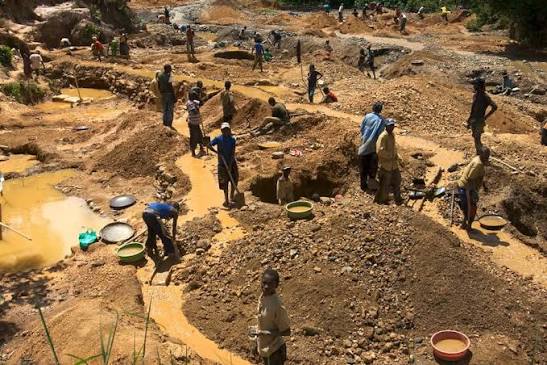
The call for a state of emergency in Ghana is growing louder as illegal mining, known locally as galamsey, continues to devastate the country. Once-pristine rivers such as the Pra, Offin, and Birim, once sources of clean water and livelihoods, have now turned into brown, toxic streams. Cocoa farms, the pride of Ghana’s agricultural wealth, are being cleared for shallow pits. Forests lie bare. Communities face poisoned water, ruined farmland, and in some cases, death from violent clashes between miners and security forces.
Speaking on behalf of government, Hon. Felix Kwakye Ofosu acknowledged the seriousness of the matter, stressing that “the option of declaring a state of emergency is still on the table.” His words suggest that government has not ruled out decisive constitutional measures, though it continues to weigh the legal and political consequences.
Meanwhile, debate has sharpened around the proposed repeal of portions of the Minerals and Mining Act, 2006 (Act 703) and L.I. 2462, the legislative instrument that permits mining in forest reserves. The Acting Chief Justice recently warned, “We cannot continue to dither in September 2025 on the repeal of L.I. 2462 that has permitted mining in forest reserves. It is a good place to start if we are serious about protecting what is left of our environment.” Proponents insist these laws must be revised to close loopholes exploited by illegal miners and their financiers. They argue that without strong legal reforms, a state of emergency alone will not stop the menace.
Several voices outside government have raised the alarm. Nana Ohene Ntow, former General Secretary of the NPP, has warned that “galamsey poses more threat than a civil war.” The Coalition Against Galamsey, a civil society group, has likewise called for swift intervention, describing the crisis as an attack on Ghana’s survival. Their concern reflects what many Ghanaians feel: that the nation’s water, land, cocoa farms, and very future are under siege.
Under Article Thirty-One of the 1992 Constitution, the President has authority to declare a state of emergency where there is imminent danger or a breakdown of law and order. Such a declaration permits curfews, restrictions on movement, suspension of certain rights under Article Thirty-Three, and the deployment of the security forces. Mining sites could be closed immediately, and offenders punished. But there are strict checks. The declaration must be laid before Parliament within seventy-two hours and must be approved by a two-thirds majority. Any extension also requires approval, ensuring accountability.
By law, a state of emergency in Ghana can bring sweeping changes. To begin with, government may restrict movement and impose curfews in affected areas. In addition, it may suspend certain fundamental rights, though some, such as the right to life and human dignity, can never be touched. Beyond that, the armed forces and police may be deployed with expanded powers to restore order and protect resources. Furthermore, the state may take temporary control of land or property needed for emergency operations. Finally, illegal activities that threaten national security or public safety can be shut down at once, including mining sites at the heart of the crisis.
Ghana has precedents. In the First Republic, President Nkrumah used emergency powers during national security threats, including the Congo crisis in 1961. Later governments, including the PNDC in the 1980s, relied on emergency powers during instability. More recent emergencies have been declared in times of disaster, such as floods. These examples show that the Constitution allows extraordinary measures in extraordinary times.
Proponents argue that galamsey qualifies as such a threat. They point to dying rivers, vanishing forests, collapsing farmlands, and poisoned communities. If cocoa farms continue to fall, Ghana risks losing its place as the world’s second-largest cocoa producer. For them, this is not just an environmental concern but a matter of national security.

Yet other approaches exist. Critics argue that declaring a state of emergency would only bring temporary relief. Poverty, joblessness, and weak enforcement drive young people into illegal mining, and those problems cannot be solved by curfews or soldiers alone. They call for a mix of strategies: reforming mining laws, strengthening institutions like the Environmental Protection Agency, enforcing the Minerals and Mining Act, formalizing small-scale mining, and providing alternative livelihoods for the youth. Community education and stricter monitoring of foreign involvement, particularly in financing and equipment, are also seen as vital.
The debate has reached a defining moment. Will President Mahama ultimately concede to the growing calls to exercise this constitutional power? We shall keep our readers updated on any next proclamation by government.
By Julius Blay JABS