








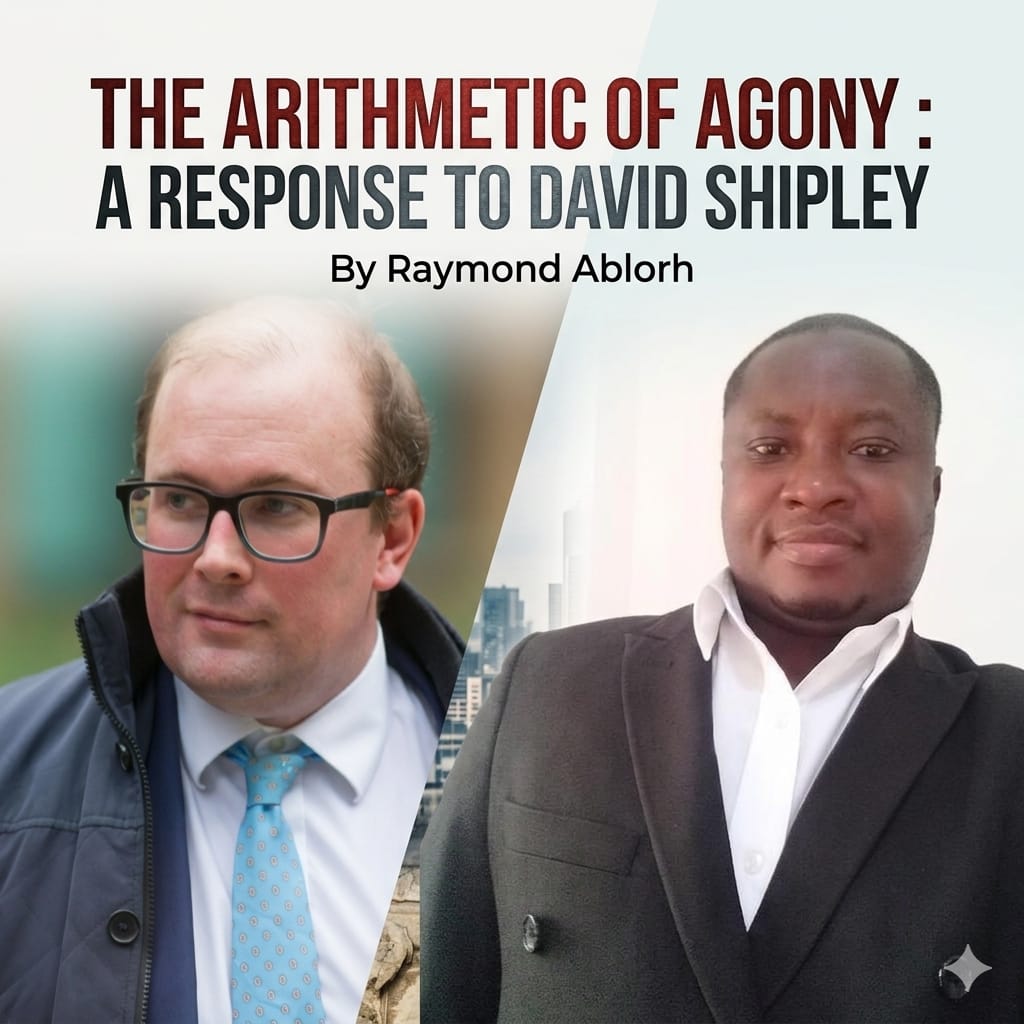
There is a peculiar brand of arrogance that allows a man to set fire to a neighbour’s house, warm his hands by the flames, and then, while standing upon the charred remains, lecture the survivor on the virtues of “moving forward.”
In his recent discourse, David Shipley characterizes the UN’s stance on reparations as “nonsense.” To suggest that the demand for reparatory justice is a foolish indulgence is not merely a historical oversight; it is a profound moral bankruptcy. It is the height of colonial hangover to assume the books are closed on a crime that effectively financed the very architecture of the modern Western world.
Let us be clear: no amount of Sterling, Dollars, or Euros can ever truly settle the debt of the Transatlantic Slave Trade. You cannot put a price on the systematic dehumanisation of a race. You cannot issue a cheque for the soul of a continent.
However, to use the “incalculable” nature of the damage as an excuse for dismissal, as Shipley suggests, is a cowardly retreat into semantics. The Transatlantic Slave Trade was not a mere “partisan resolution” or an unfortunate chapter; it was the gravest crime against humanity.
This industrial-scale extraction of African life and spirit provided the raw capital for Britain’s Industrial Revolution. While your ancestors were building global hegemony on the proceeds of our pain, ours were being stripped of their names, their tongues, and their very humanity.
To the critics who claim we should “focus on the future,” I ask: with what tools? The mental and psychological harm caused by centuries of chattel slavery and subsequent colonial exploitation is the bane of Africa’s development. It is a generational trauma that has mutated into systemic economic disenfranchisement.
You speak of “partisan” politics as if Africa is running a race on a level track. You conveniently forget that for four hundred years, we were the track. The argument that current generations should not bear the “guilt” of their ancestors is a convenient straw man. This is not about individual guilt; it is about institutional responsibility.
The British State, the Church of England, and the financial institutions of the City of London are the direct beneficiaries of this “original sin.” They are the trustees of stolen wealth. The interest on that wealth continues to accumulate in Western vaults while African children are born into a poverty engineered by your predecessors.
We do not seek “charity.” We do not ask for “aid”, which is often just a recycled form of the very wealth stolen from us. We demand reparatory justice. This encompasses formal apologies, not the mealy-mouthed expressions favoured by politicians, but a full-throated admission of the crime.
It requires restitution: the return of our looted cultural artefacts and a structural re-engineering of a global financial system that continues to penalise the Global South. History is not a series of isolated events; it is a continuous flow of causality. To deny reparations is to deny historical causality itself. You cannot enjoy the fruit and deny the existence of the root.
The “Triple Burden” of slavery, colonialism, and neo-imperialism has left an indelible mark on the African psyche. It created a world where Blackness was equated with “property” and Whiteness with “providence.”

As the UN resolution highlights, the world is watching. Britain’s decision to abstain, rather than confront its legacy, is a missed opportunity for moral leadership. The wind of justice is no longer a breeze; it is a gale.
To David Shipley and those who share his dismissive view: your “civilisation” was bought with our blood. Your “freedom” was paid for with our chains. If you truly believe in the values of “justice” and “fair play,” then prove it. Acknowledge the debt. Address the harm.
Until there is an honest accounting of the past, your “future” will always be haunted by the ghosts of our ancestors. The sun has finally set on the empire of denial. It is time for the dawn of redress.
By Raymond Ablorh