








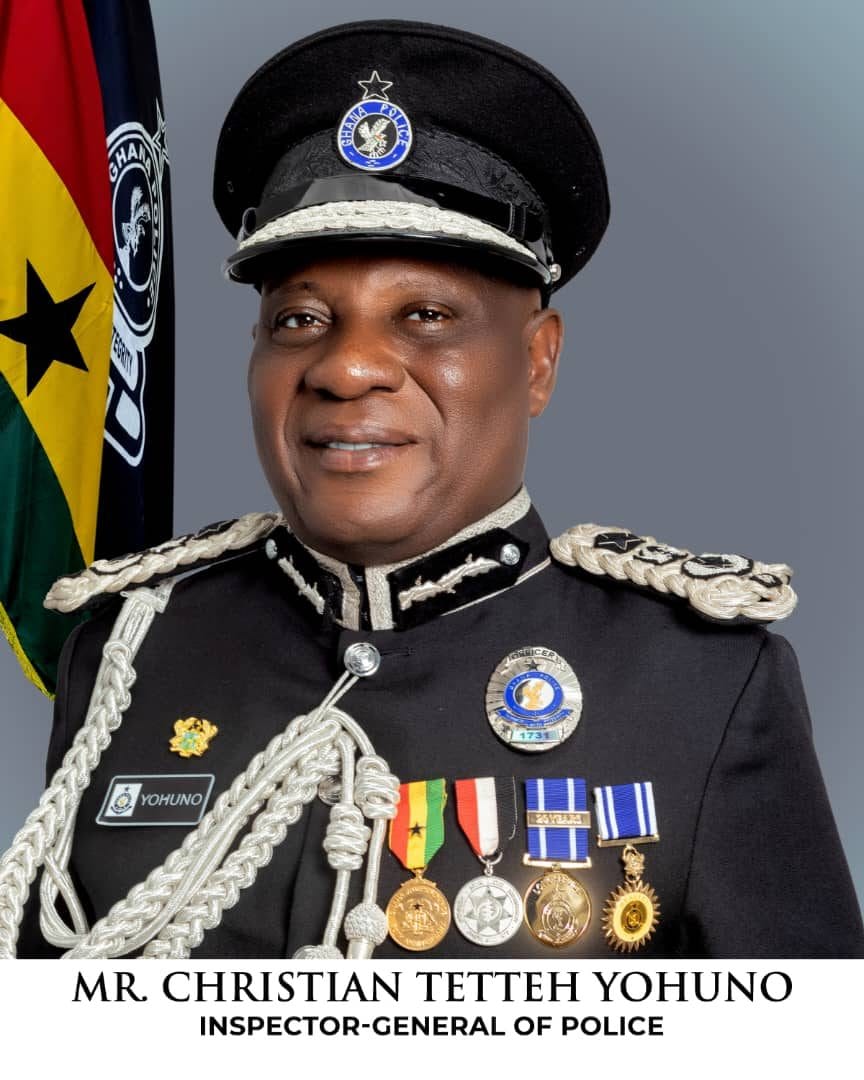
In the quiet hours before the Ghanaian dawn, when the pulse of the nation beats at its most vulnerable, a silent sentinel stands guard. Security is not merely the absence of noise; it is the presence of an invisible, unbreakable shield forged in the fires of discipline.
For forty years, one man has walked the thin, blue line between chaos and community, proving that the highest form of power is not found in the holster, but in the heart. As Mr Christian Tetteh Yohuno marks four decades of service, his story becomes more than a biography; it is a blueprint for the redemption of public trust.
The moral compass of a nation is often calibrated by the conduct of those who wear its brass. In an era where institutional decay is frequently lamented as an inevitability, Yohuno’s trajectory from a young recruit to the apex of the Police Service serves as a stubborn rebuttal to cynicism.
His career has not been a sprint toward the finish line of high office, but a marathon of meticulous consistency. He has understood a fundamental truth that many in the corridors of power ignore: a leader who cannot account for a cedi cannot be safely entrusted with a life.
The brilliance of his tenure is most visible in the ledger of accountability. Under his stewardship, the Ghana Police Service has ascended to the enviable position of the second most compliant institution in the management of public funds as of March 2026.
This is no mere administrative footnote; it is a profound declaration of ethical sovereignty. In a landscape where the “leakage” of state resources is often treated as a customary tax, Yohuno has plugged the holes with the sealant of personal integrity. He has transformed the Service from a mere consumer of the national budget into a disciplined custodian of it.
Critics often mistake silence for a lack of action, yet in the Yohuno era, silence is the sound of efficiency. He has replaced the theatre of law enforcement with the theology of results.
By integrating advanced E-Case Management systems and digitizing the Motor Traffic and Transport Department (MTTD), he has removed the “human element” that so often invited the “greased palm.” Technology, in his hands, is not just a tool for modernization; it is a weapon for moral cleansing. He has successfully argued that to digitize the process is to dignify the citizen.
The symbolism of his journey is impossible to miss. Like the Ghanaian Gye Nyame, his authority is rooted in a deep-seated acknowledgement of a higher moral law. He has navigated the turbulent waters of political transitions and social upheavals with the steady hand of a seasoned navigator.
Whether staring down the barrel of a transnational crime syndicate or mentoring a new batch of Community Police Assistants, his standard remains unmovable. He represents the “Golden Mean”, the perfect balance between the iron fist of the law and the velvet glove of community empathy.
We must ask ourselves: what does a nation owe a man who has given it forty years of his sleep so that we might have ours? The answer lies not in plaques or hollow praise, but in the emulation of his “Standard of Integrity.”

His legacy is not written in the ink of his appointment letter, but in the reduced crime statistics and the renewed confidence of the Ghanaian mother who no longer fears the night. As we look toward the horizon of 2027 and beyond, the Yohuno doctrine provides a clarity that transcends the Police Service.
It speaks to the parliamentarian, the civil servant, and the common citizen alike. It reminds us that institutional greatness is not a gift from the state; it is a collective achievement of individuals who refuse to compromise.
Mr Christian Tetteh Yohuno has not just led a force; he has curated a culture. He has shown us that the most potent weapon in any arsenal is a clean hand. In the grand theatre of national history, many will be remembered for the noise they made, but the 31st IGP will be remembered for the peace he sustained.
He remains, as he has always been, the silent architect of our order, a man whose compass has always pointed due North, toward the enduring light of truth.
The author, Raymond Ablorh is a highly revered professional Ghanaian Journalist and Strategic Communications Consultant with over 25 years of mass communication experience. He started writing for Daily Graphic in December, 2000 before expanding his scope on both local and international media landscapes. After serving the global media development giant Deutsche Welle (DW), he joined Telco giant Airtel Ghana, as their Communication Manager, from where he became a strategic communication consultant.
By Raymond Ablorh