







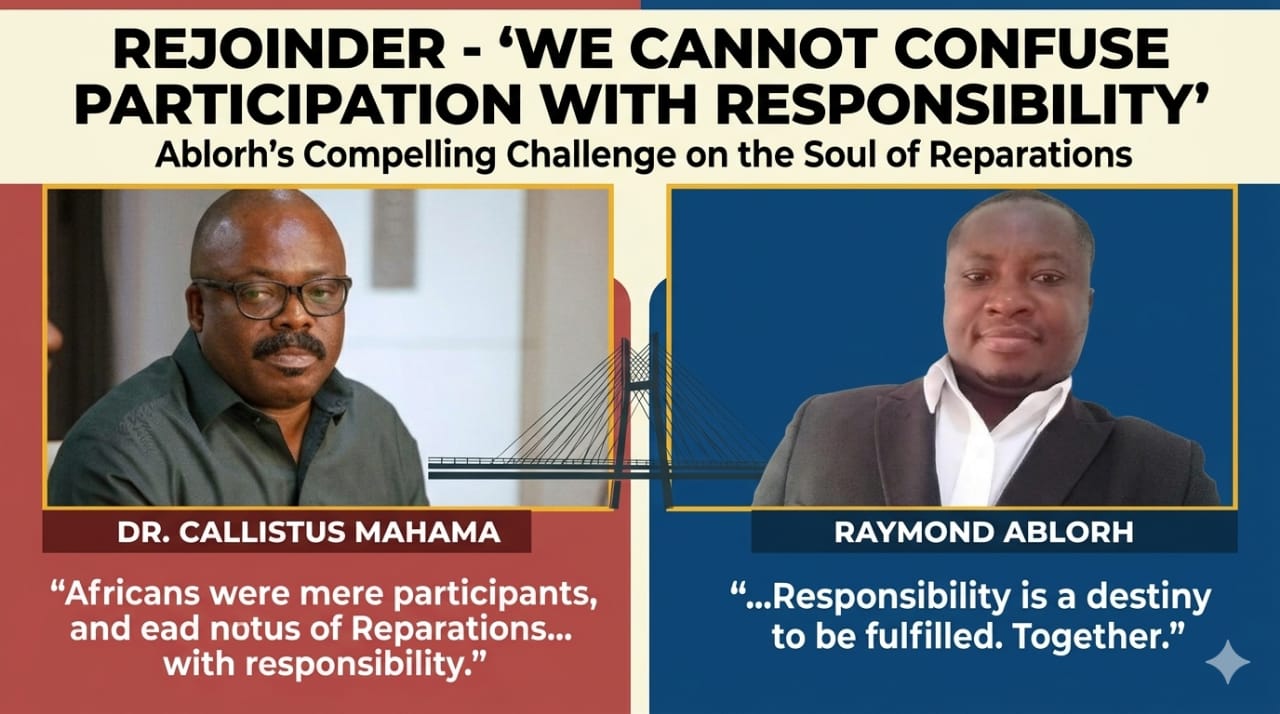
In his recent philosophical autopsy of the Transatlantic Slave Trade, Dr Callistus Mahama performs a delicate surgical operation on the African conscience. He attempts to sever the nerves of “participation” from the muscle of “responsibility.”
He argues that while our ancestors were active in the trade, the primary burden of repair lies with the European architects who designed the machine. It is a distinction that is as academically neat as it is morally hazardous.
To suggest that one can participate in the erasure of a soul without bearing the weight of that act is to offer a sedative where a stimulant is required. It may ease the historical headache, but it leaves the underlying pathology untouched.
Dr Mahama posits a hierarchy of culpability where responsibility is a concentrated essence, held tightly by colonial masters, while “participation” is a peripheral involvement forced upon the indigenous.
I submit, however, that responsibility is not a baton to be passed only to the winner of a race; it is the very track upon which the relay of human agency is run.
If we participated in the bartering of a brother, we are inherently responsible for the vacuum created by his absence. To decouple the two is to invite a ghost into our modern halls of power, a phantom of authority that claims the right to lead but denies the duty to repent.
We must confront the cold, hard logic of our sovereign identity. A people cannot be “Sovereign” when demanding reparations, yet “Helpless Participants” when discussing their complicity.
In the theatre of history, there are no mere extras; there are only actors with varying degrees of agency. When Dr Mahama argues that participation does not equate to responsibility, he inadvertently constructs a fortress of plausible deniability for the contemporary ruling class.
If the ancestors were “participating” but not “responsible,” then when the modern state fails its people, the leader is merely a participant in a global economic system he did not build. This is a moral asymmetry we can no longer afford.
The history of our continent is littered with the wreckage of “intermediaries” who thought they could outsmart the system by joining it. We are told the African king was a victim of circumstance, yet he held the sword that captured the captive.
True responsibility is the daughter of genuine agency. You cannot help steer the ship of trade and then claim you had no say in the destination of the cargo.
If we accept the Mahama Doctrine, we accept a diluted African agency. We become a nation of “contributors” to a tragedy rather than “owners” of our history.

But the spirit of our liberation thunders with the necessity of truth. It is the ultimate aphorism of our dignity: the hand that holds the power must also hold the burden.
We do not lose our claim to reparations by admitting our complicity; we strengthen it by proving we are a people capable of the highest form of thinking, the ability to hold ourselves to the same standard we demand of the world.
Justice is not a product delivered by a benevolent West; it is a fire kept burning by the collective breath of an honest populace. When we demand that Europe pays for its crimes, we must also ensure that we have purged the “participatory” spirit of exploitation from our own borders.
To suggest that the African participant is blameless because he did not own the ship is to treat the African as a decorative element in history, rather than the foundation stone of his own destiny.
Dr Mahama, a scholar of high standing, surely understands that power, when isolated from accountability, becomes a tumour. It grows for its own sake, at the expense of the truth.
The bridge between the past and the future is not built of “participation”; it is built of shared consequence. If we are to move from the “whisper” of a demand to the “thunder” of a reality, we must collapse the wall between the office and the street.
I invite the learned Doctor to step out of the ivory tower of definitions and into the light of total transparency. Let us have a conversation not about where your liability ends and mine begins, but about how we can merge our truths into a singular, unbreakable force for continental renewal.
In the final analysis, a nation that confuses its people for mere participants in their own tragedy is a nation that has already lost the script of its future. Responsibility is not a burden to be shifted; it is the only crown worth wearing.