







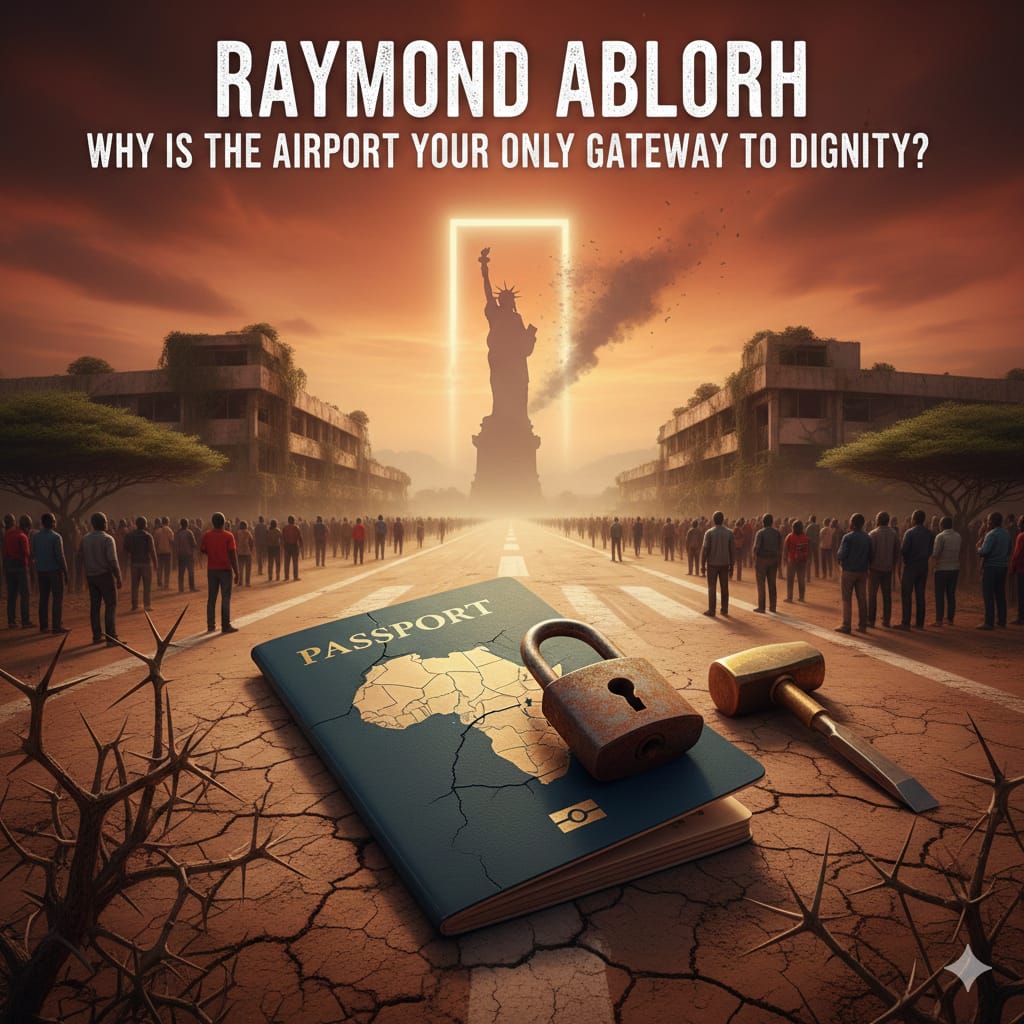
For the African elite, the departure lounge at Kotoka or Murtala Muhammed has long been more than a transit point; it is a confessional where they renounce their citizenship in exchange for a temporary sense of humanity.
They spend their days plundering the commonwealth, siphoning the lifeblood of the “richest but poorest” continent into private coffers, only to spend those spoils in London, New York, or Toronto.
They treat their birthplaces as extraction zones. They view Africa as a dark, humid transit lounge where they wait for the next flight out to a world someone else built.
But as of January 2026, the iron curtain of the West has finally fallen. With the United States’ sweeping suspension of immigrant visas and the tightening of “public charge” barriers, the escape hatch has been bolted shut.
The “America First” doctrine has inadvertently done for Africa what sixty years of independence speeches could not. It has trapped the African mind in the African reality. Why is it that for the Black African, dignity is a commodity that can only be imported?
Observe the “airport accent,” that pathetic linguistic gymnastics performed by the local traveller before the plane even clears the tarmac. It is the audible manifestation of a deep-seated inferiority complex. It is the sick belief that by mimicking the master’s tongue, one is cleansed of the “curse” of the birthplace.
We see this sickness in the government official who allows his local hospitals to rot into morgues because he has a visa for the Mayo Clinic. We see it in the “Religious Prophet” who markets a US Green Card as a spiritual breakthrough, as if the Almighty Himself has turned His back on the African soil.
This is the psychological residue of slavery and colonialism that we refuse to wash away. We are the great-grandchildren of the enslaved who now voluntarily seek the master’s kitchen. We are convinced that working for them and schooling among them makes us superior to our compatriots who remain in the trenches.
We know the weekly wages of foreign footballers with religious devotion, yet we cannot name the mineral deposits in our own backyard. We ignore the terms of the contracts that give our resources away for a pittance while we chase the shadow of foreign approval.
The Chinese did not wait for an apology from history. They did not pray for visas to the West as a “blessing” to escape their poverty. They understood that dignity is not a gift from a foreign consul; it is a product manufactured in the factory, the laboratory, and the boardroom. They stayed, they built, and they forced the world to come to them.
What is the Black African’s excuse? Is it still slavery? Is it still colonialism? No. Today’s neo-colonialism is a choice. It is a choice to remain a consumer of other people’s civilizations while our own “acidic poverty” burns the feet of our children.
The new US foreign policy, the Great Closure, is the blessing we didn’t ask for but desperately needed. When the President can no longer fly to London for a check-up, he will finally notice the lack of oxygen tanks in the local ward. When the crony’s son can no longer hide in a British university, the quality of the local classroom becomes a matter of domestic security.
We have siphoned our riches into foreign banks, enriching the very people we claim oppressed us, while leaving our brothers and sisters to suffer deprivation. We have treated our continent like a burning building, constantly looking for the fire exit rather than picking up a bucket of water. But the fire exit is now locked.
If you have nowhere to go, you shall develop your birthplace. This is the ultimate law of national survival. The era of the “exit option” is over. We must now confront the filth, the corruption, and the mediocrity we have allowed to fester. We must trade the “airport accent” for the “architect’s plan.”

The West has closed its doors. It is time we opened our eyes. Dignity does not live in a foreign passport; it lives in the quality of the water in your taps, the asphalt on your roads, and the integrity of the men in your high offices. If the world will not have us, let us build a world where we finally want to have ourselves.
By Raymond Ablorh