








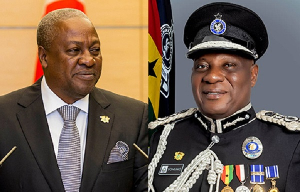
The Presidency was under siege, not by mortars, but by pixels. In a cold-blooded digital ambush, sophisticated AI-generated videos surfaced across social media, hijacking the likeness of President John Dramani Mahama and the First Lady, Mrs. Lordina Mahama, to front a global investment scam.
But the “invisible” assassins underestimated the resolve of the state. In a display of swift, surgical competence, the Inspector-General of Police (IGP), Christian Tetteh Yohuno, directed a high-stakes intelligence operation that resulted in the arrest of two key suspects.
By neutralizing this threat, the IGP has not only saved the President’s family from a vicious character assassination but has sent a thunderous message: the law is faster than the algorithm.
The deepfake is the modern assassin’s blade: silent, invisible, and devastatingly effective. It is a weapon designed to auction the credibility of our national leaders to the highest bidder in the dark corners of the web.
When a citizen clicks “share” on content designed to deceive, they are not a passive observer. They are an accomplice to a digital crime. As the Ghana Police Service rightfully asserts, the era of “innocent sharing” is over. We have entered the age of digital complicity.
IGP Yohuno and the top hierarchy of the Police Service have defined a red line in the shifting sands of the internet. The arrest of the two suspects is the first blow in a wider war against technological banditry.
Our statutes, specifically the Cybersecurity Act (Act 1038) and the Criminal Offences Act, are no longer antiquated relics. They are living instruments of justice. Under Section 63 of Act 1038, the production or sharing of harmful digital content is a punishable offence.
The police are no longer just patrolling our streets; they are patrolling our screens. They are reaching into the encrypted shadows to hold the malicious and the negligent to account.
A deepfake can destroy a reputation in seconds, incite communal violence in minutes, and destabilize a democracy in hours. To create such content is an act of malice; to circulate it is an act of recklessness that the state can no longer indulge.
The logic is simple but profound: if you facilitate the spread of a lie, you are responsible for the wreckage it leaves behind. We cannot build a nation of integrity on a foundation of digital hallucinations.
The Police Service’s stance is a clarion call for a “National Reset” of our digital ethics. It is a demand that we transition from being mere consumers of content to being custodians of truth.

This is not a battle for the police alone; it is a collective struggle for the soul of our society. However, the police must remain the “Sword” of enforcement and the “Shield” of the vulnerable.
Under the leadership of IGP Yohuno, the commitment to protecting the First Family and every Ghanaian citizen from digital assault is the only deterrent against a future where reality is up for sale.
The message is crystalline: verify before you vilify. Think before you trigger a crisis. If you choose to be a conduit for deepfake deception, do not be surprised when the full force of the law meets you at your doorstep.
Justice is no longer just blind; in the digital age, it has become technologically sovereign. The law is awake, the police are vigilant, and the truth shall be defended with the uncompromising power of the Constitution.
By Raymond Ablorh