



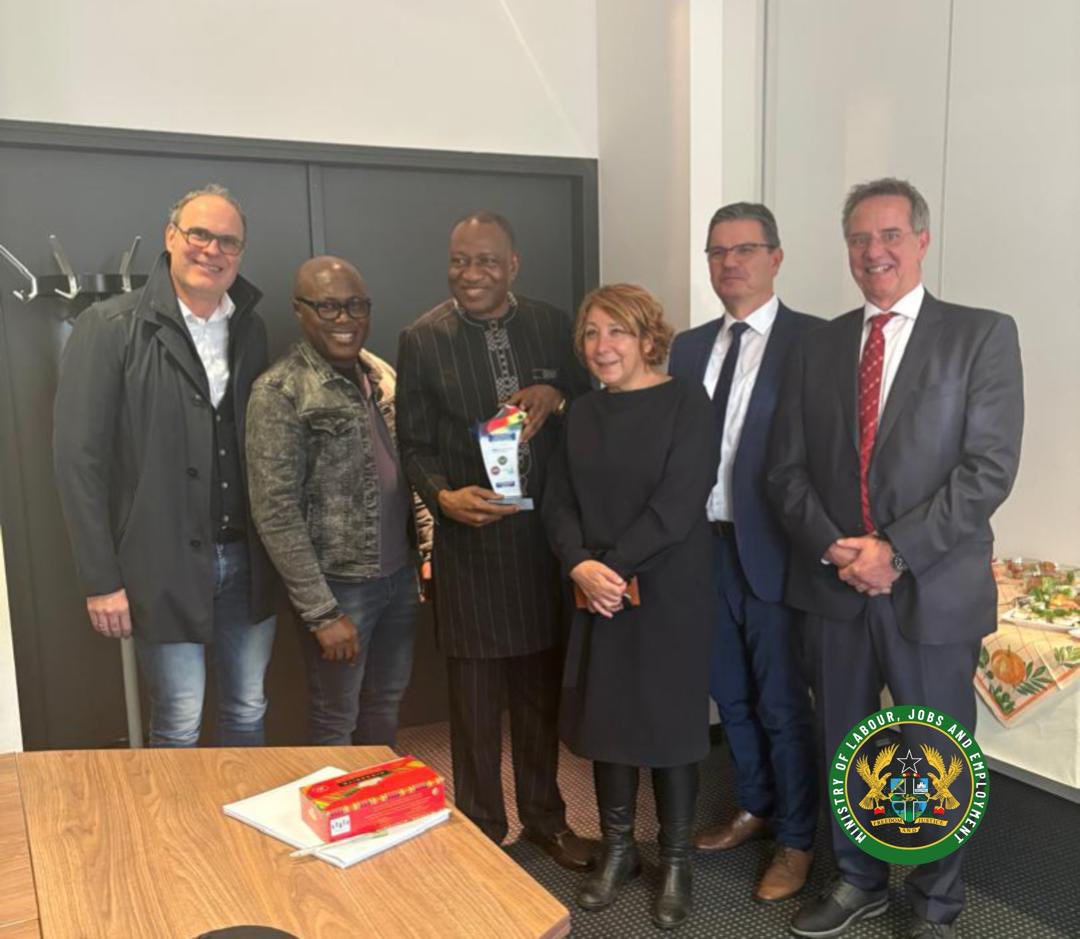
Ghana and Germany have finalized a bilateral employment and training initiative that will create a new pathway for young Ghanaians to acquire technical skills and employment opportunities in Germany. The agreement, reached during a high-level working visit by Ghana’s Minister for Labour, Jobs and Employment, Hon. Dr. Rashid Hassan Pelpuo, marks the formal establishment of the ROCET Employment Pathway, a groundbreaking partnership that will see the first cohort of 30 Ghanaian trainees begin a three-year program in 2026.
The finalized framework follows extensive discussions between the Ghanaian delegation and officials of Berufsförderungswerk der Bauindustrie NRW (BFW), a leading German training institution, and its Ghanaian partners, Dominion Leaders Foundation (DLF) and RETOG. During the meeting, BFW’s Innovation Manager, Dipl.-Soz-Päd. B. Müller, presented the operational structure of the program, which is designed to ensure transparency, quality selection, and the long-term success of participants.
Under the agreement, recruitment will be led jointly by the Ministry of Labour, Jobs and Employment, Dominion Leaders Foundation, and RETOG, targeting Ghanaian youth aged between 18 and 30 who are eager and qualified to pursue technical careers in Germany. Selected applicants will undergo profiling and counselling by DLF and BFW to align their skills and interests with available trade areas. DLF and RETOG will then facilitate German language and cultural preparation, with candidates required to attain certification at levels A1, A2, B1, or B2 before participating in employer interviews organized by BFW.
The interviews, which will include prospective German employers, will determine final candidate selection. Successful applicants will receive employment offers through BFW and DLF and will be guided by the Ministry and DLF in securing the necessary visas and travel documentation. Candidates will bear pre-departure costs, but upon arrival in Germany, they will receive a monthly allowance for the duration of their three-year program, approximately €1,000 in the first year, €1,200 in the second, and €1,500 in the third year.

During the discussions, Dr. Pelpuo emphasized Ghana’s commitment to making the program a sustainable avenue for job creation and skills transfer. He proposed an annual intake of 30 trainees and expressed confidence in Ghanaian youth, stating, “Be prepared to receive even more than 30. We have a pool of brilliant young people who are poised to not only learn the language but also excel in their fields.” He also commended DLF’s profiling model as a vital component for the program’s success.
DLF’s Executive Director, Martha Akoibea Anang, called for inclusivity in the selection process, suggesting that candidates who do not attain the B2 proficiency level should be offered alternative training or employment pathways. BFW welcomed the suggestion and pledged to explore partnerships with other recruitment and training institutions to expand opportunities for Ghanaian youth in additional trade sectors.
BFW’s Chief Executive Officer, Dr. Bernd Garstka, described the partnership as a turning point in Ghana–Germany cooperation on employment and training. “This meeting has moved the ROCET project from a vision to a concrete, actionable plan,” he said. “We are not just creating jobs; we are building careers and fostering a deep exchange of skills between our nations.”
The ROCET Employment Pathway represents a collaborative effort between the Ministry of Labour, Jobs and Employment, BFW, DLF, and RETOG to address youth unemployment through international training and placement. With recruitment for the inaugural batch set to begin in 2025, the initiative is expected to serve as a model for sustainable, skills-based migration and employment partnerships between African and European countries.