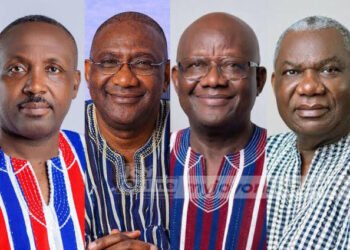








The Governor of the Bank of Ghana, Dr. Johnson Pandit Asiama, met with the Committee on Economy and Development of the Parliament of Ghana on Monday, 9 March 2026, at the Parliament House.
The meeting was to brief Committee members on the Bank’s 2025 Monetary Policy Report. Discussions covered various economic issues, including reserve management, inflation, interest rates, and external sector risks like the Middle East unrest. Dr. Asiama highlighted Ghana’s economic developments, monetary and fiscal policy formulation, and the Bank’s reserve diversification and gold portfolio management.
The Chairman of the Committee, Dr. Eric Afful, Member of Parliament for Amenfi West Constituency, expressed satisfaction with the Governor’s open and frank discussions on the issues raised, and urged the Bank to be engaging more with Parliament to curb misinformation and disinformation.
Bank of Ghana Governor’s Statement Highlights Economic Progress and Policy Actions
In a recent statement to the Parliamentary Committee on Economy and Development on Monday, March 9, 2026, Dr. Johnson Pandit Asiama, Governor of the Bank of Ghana, outlined the economic conditions at the beginning of 2025 and the policy measures undertaken by the Bank.
Initial Economic Conditions (2025)
– Ghana faced significant challenges in early 2025 following a sovereign debt restructuring, sharp currency depreciation, and a surge in inflation in 2024.
– Inflation ended 2024 at 23.8%, above the Bank’s medium-term target band of 8 ± 2 percent.
– The Ghanaian cedi depreciated by 24.8% in 2024, contributing to imported inflation.
– The economy was fragile with high inflation eroding household purchasing power and complicating business planning.
Policy Actions Taken
The Bank of Ghana implemented several policy measures:
– Maintaining a Tight Monetary Policy Stance: The Monetary Policy Committee kept a tight stance to contain inflation and anchor expectations.
– Addressing Excess Liquidity: Actions included increasing the frequency and volume of OMO issuance throughout 2025, active sterilization of foreign exchange intervention inflows, and stepped-up coordination with the Ministry of Finance on government cash management.
– *Strengthening External Buffers and the Foreign Exchange Framework*: International reserves were strengthened through improved export earnings, remittance inflows, and the Domestic Gold Purchase Programme.
– *Reserve Diversification and Gold Portfolio Management*: Ghana increased its gold holdings significantly (from 8.7 tonnes in 2021 to over 40 tonnes by October 2025), representing about 42% of Gross International Reserves by October 2025.
Macroeconomic Outcomes
– Inflation Decline: Headline inflation fell from 23.8 percent in December 2024 to 5.4% by December 2025 and further to 3.3% in February 2026.
– Exchange Rate Stabilization: The Ghanaian cedi appreciated significantly during 2025, reflecting improved macroeconomic fundamentals and renewed market confidence.
– Interest Rates Reduction: The Monetary Policy Rate was reduced by 900 basis points during 2025, ending the year at 8%.
– External Buffers Strengthened: Gross international reserves increased to US$13.8 billion by the end of 2025, providing approximately 5.7 months of import cover.

Banking Sector Developments
– Total assets increased from GHC368 billion to GHC447 billion.
– Deposits grew by nearly 18 percent, rising from GHC276 billion to GHC325 billion.
– Liquidity remains strong, with liquid assets covering about 96% of deposits.
Conclusion
The Governor emphasized that these policy actions have led to significant improvements in macroeconomic stability, with lower inflation, a stabilized exchange rate, and strengthened external buffers.
The Bank of Ghana continues to pursue prudent monetary policies aimed at sustained economic recovery.