







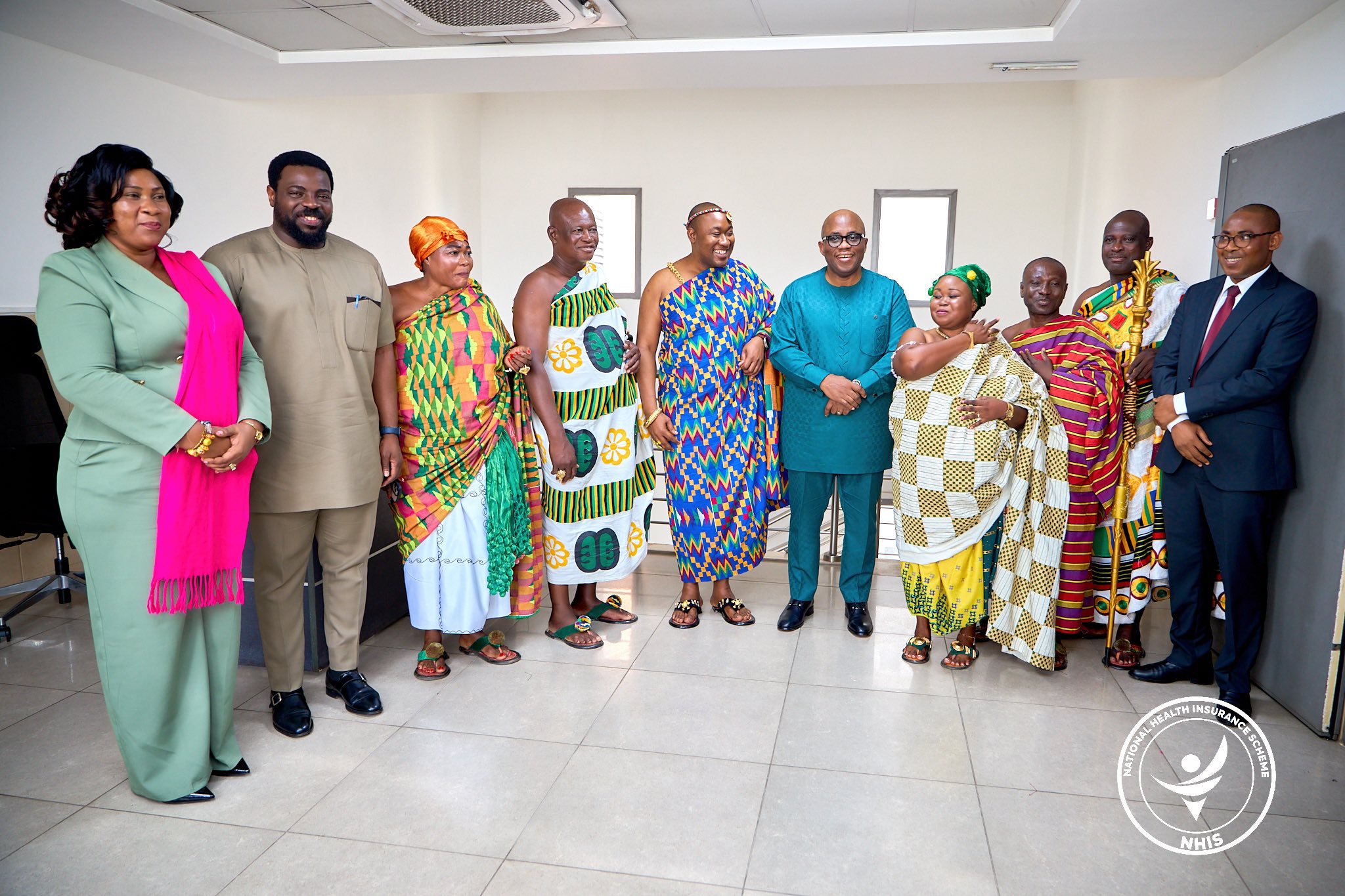
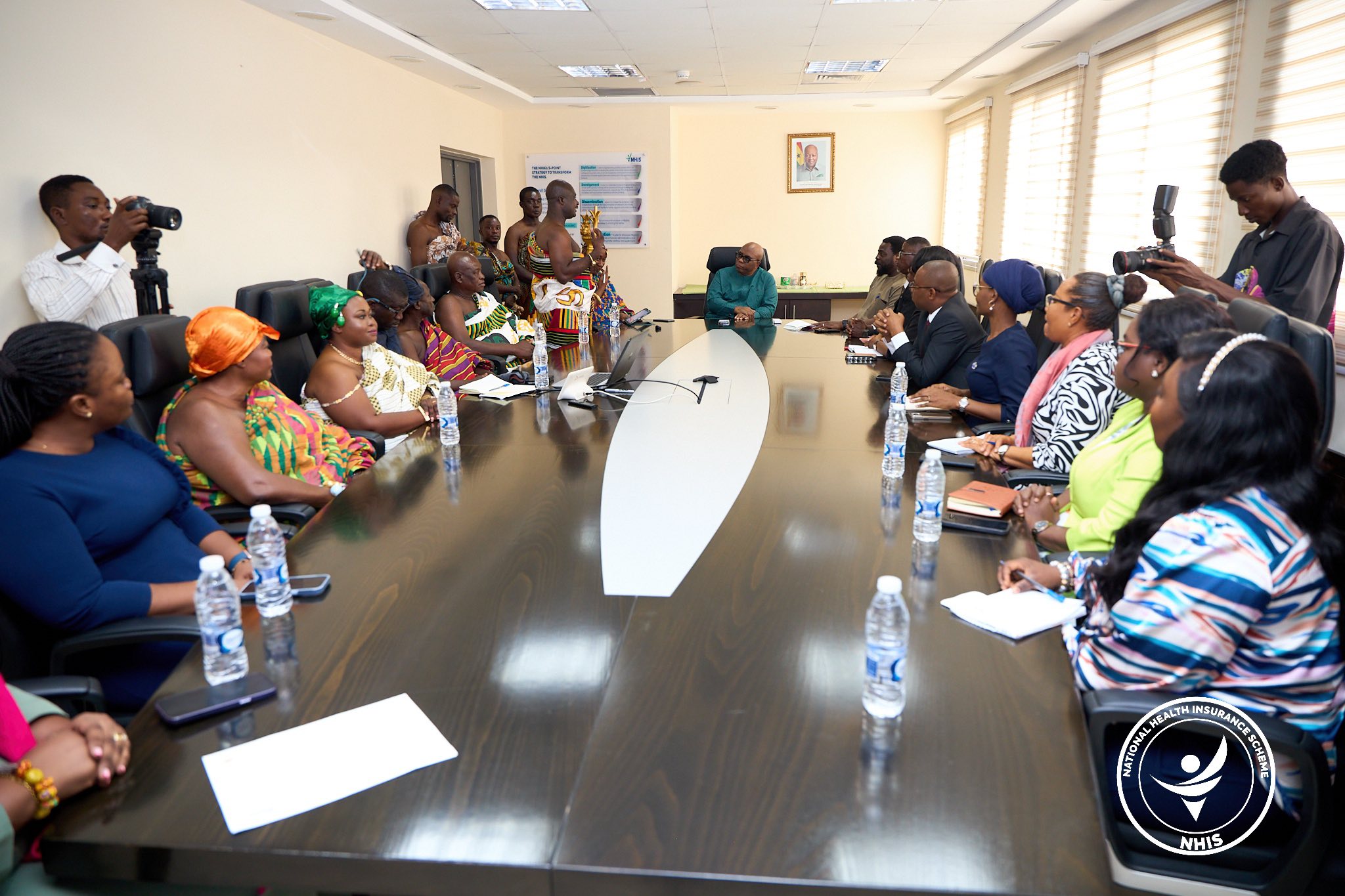
The Paramount Chief of the Atebubu Traditional Area, Ohempon Dr. Yeboah Asiamah, has paid a courtesy call on the Chief Executive of the National Health Insurance Authority (NHIA), Dr. Victor Asare Bampoe to explore mutual areas for partnerships.
He said the current remarkable strides being made by the NHIA in expanding health insurance coverage across the country was a demonstration of strong institutional commitment worthy of recognition and support.
Leading a seven-member entourage to NHIA headquarters in Accra on Tuesday, March 10, 2026, Ohempon Asiamah pledged the full backing of the Atebubu Traditional Council to the ongoing reforms at the NHIA, which he said was critical to the government’s universal health coverage drive.
He also indicated that a further purpose of the visit was to personally commend Dr. Bampoe for what he described as exemplary and transformational leadership, which has been instrumental in reviving and strengthening the NHIS, a Scheme that, only a few years ago, was on a steep decline.
“We are aware that coverage has moved from 58 per cent after so many years to 66 per cent in just a few months of your assumption of office and we think that you and your team deserve commendation.
“Sometimes when you are working you might feel no one is recognising your efforts, but behind the scenes we are monitoring. That is why we have come to encourage you and let you know that Ghana appreciates the work you are doing,” he said.

According to him, one of the common greetings in the Atebubu Traditional Area was “keep going forward,” meaning that obstacles may arise on any good journey, but perseverance remains essential.
He, therefore, urged the NHIA leadership to maintain momentum despite the challenges that accompany ambitious public health reform, lending the visit a culturally resonant tone that went beyond mere protocol.
He proposed partnership between the NHIA and the Atebubu Traditional Council on community-based outreaches aimed at boosting NHIS registration and renewals, particularly for the poor, the aged, and other vulnerable groups during their annual festive celebrations.
He said while such outreaches have been conducted before on a modest scale, a formal NHIA partnership would significantly broaden their impact.
The paramount chief also proposed strengthening the Atebubu district NHIA office to improve operational efficiency at the local level and ensure residents access the full benefits of the scheme.
He further highlighted the potential of annual traditional festivals as powerful platforms for health advocacy and enrolment drives, noting that these gatherings draw wide community participation and offer a unique opportunity to reach people who may otherwise be difficult to engage.

Dr. Bampoe, in response, attributed the current accelerated strides made by the NHIA to largely key policy reforms under President John Dramani Mahama’s “Resetting Ghana” agenda, most notably the uncapping of the National Health Insurance Fund, which has enabled more consistent and timely fund releases.
He acknowledged both the Ministry of Finance and the Ministry of Health for their support. Notwithstanding the gains, Dr. Bampoe was clear that 100 percent coverage remains the goal, with a realistic target of between 75 and 80 percent by the close of the year.
Dr. Bampoe said that despite the overall progress, the NHIS continues to battle the problem of illegal out-of-pocket charges at some health facilities, where providers bill members for services already covered under the scheme.
“The NHIA is actively working to eliminate such illegalities,” he said.
He underscored that the doors of the Authority remained open to feedback, recommendations, and corrections from all stakeholders.
The Deputy Chief Executive in charge of Operations, NHIA, Dr. Senanu Kwesi Djokoto, reinforced the NHIA’s commitment to strengthening services of the Scheme, particularly, in Atebubu.
“We are very interested in the partnership you have proposed and will work with you to ensure that at least we achieve UHC in Atebubu,” he said.
He noted that such partnerships were very critical, as traditional rulers were uniquely positioned to drive development, acknowledging that their words carried authority within their communities.