







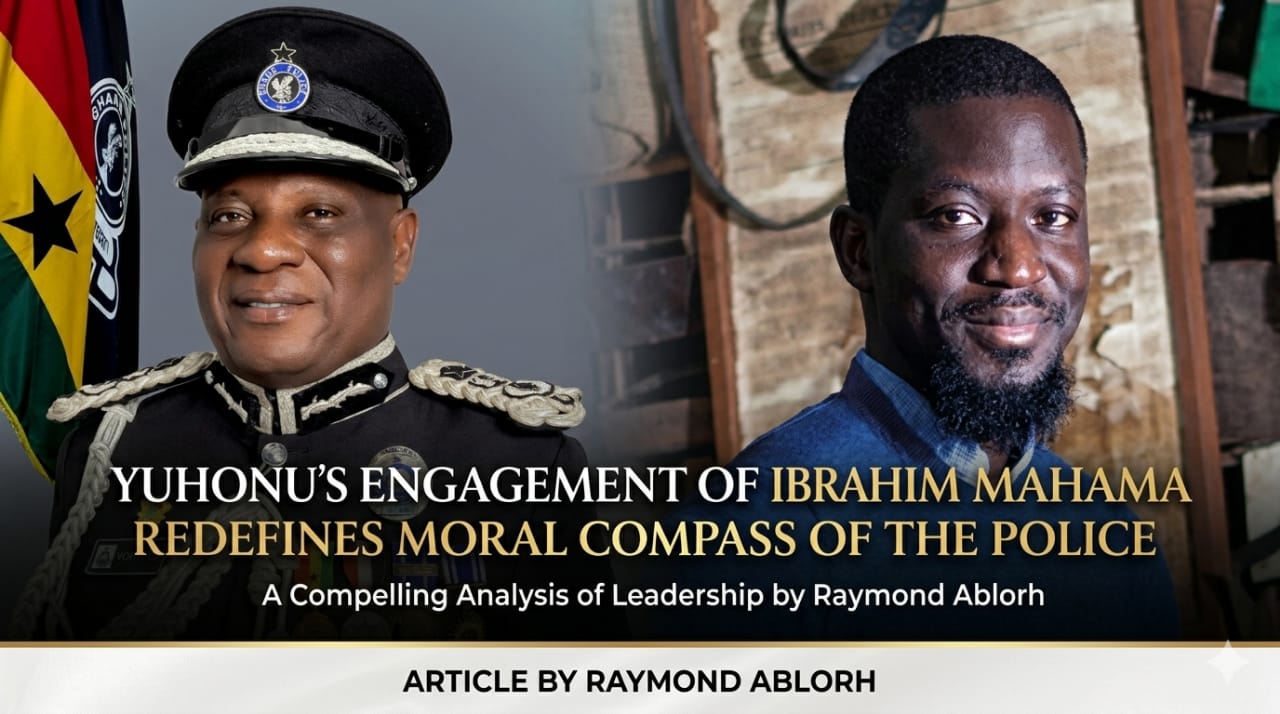
In the high-stakes theatre of national security and public order, leadership is often mistaken for the rigid application of force. Yet, as the sun sets over Accra this Thursday, a different kind of power is on display, not the power of the baton, but the transformative power of the olive branch.
By inviting the internationally acclaimed visual artist Ibrahim Mahama to a personal engagement following his recent ordeal, the Inspector-General of Police (IGP), Christian Tetteh Yohuno, has done more than manage a crisis; he has redefined the moral compass of the Ghana Police Service.
This was not merely a meeting; it was a symbolic bridge built over a widening chasm of public distrust. When the “Black Maria” incident in Tamale first broke, the air was thick with the familiar scent of institutional denial.
We have seen this script before: the defensive press release, the categorical denial of involvement, and the eventual fading of the victim’s voice into the archives of unresolved grievances. But IGP Yohuno chose to shred that script. By bringing Mahama into the inner sanctum of the Police Headquarters, the IGP transitioned the narrative from one of state-sponsored trauma to one of systemic rectification.
At the heart of this engagement lies a rare trait in African bureaucracy: the courage to listen. To have the Director-General of the Police Professional Standards Bureau (PPSB) and the Criminal Investigations Department (CID) in the same room as a citizen seeking justice is a profound statement of intent. It suggests that the Police Service is no longer a closed shop, protecting its own at the expense of the truth.
The directive to have the CID Headquarters take over the probe from the Northern Regional Command is a tactical masterstroke. It acknowledges a fundamental principle of natural justice, that one cannot be a judge in their own cause.
By elevating the investigation to the highest level of scrutiny, Yohuno has effectively insulated the process from local biases and potential cover-ups. This is leadership that understands that for justice to be done, it must, above all, be seen to be done.
While Ibrahim Mahama is a titan of the global art world, a man whose installations speak to the soul of nations, this engagement is not just about a celebrity. It is a victory for the ordinary Ghanaian who fears the siren and the uniform.
The IGP’s reassurance that “anyone found culpable would face the full rigor of the law” is an aphorism for a new era. It signals that in the eyes of this administration, the law is a leveler, not a tool for the privileged or a shield for the errant officer.
We must see this through the lens of institutional health. A police force that cannot apologize or introspect is a force that is dying from within.
By acknowledging Mahama’s “long-standing positive relationship with the police,” the IGP humanised the institution. He reminded us that the police and the public are not antagonists in a zero-sum game, but partners in the grand project of nation-building.
Skeptics may call this optics. I call it architecture. Just as Mahama uses jute sacks to wrap monumental buildings to reveal their hidden histories, Yohuno is wrapping this crisis in a layer of transparency to reveal the potential for a reformed service.

The postponement of Mahama’s lectures at Cambridge and Oxford is a loss to the global academic community, but the IGP’s intervention might well become the most important lecture delivered on Ghanaian soil this year: a lecture on the sanctity of human rights.
As we move forward, the “Yohuno Precedent” must become the “Yohuno Standard.” Leadership is not found in the absence of mistakes, but in the presence of the character required to fix them. The IGP has shown that he possesses the mettle to lead a service that is both feared by criminals and loved by the law-abiding.
In the final analysis, this engagement is a testament to the fact that when a leader chooses empathy over ego, the entire nation wins.
The Inspector-General has not just saved a reputation; he has ignited a flicker of hope that, perhaps, we are finally entering an age where the state exists to serve the citizens, and not the other way around.
By Raymond Ablorh