







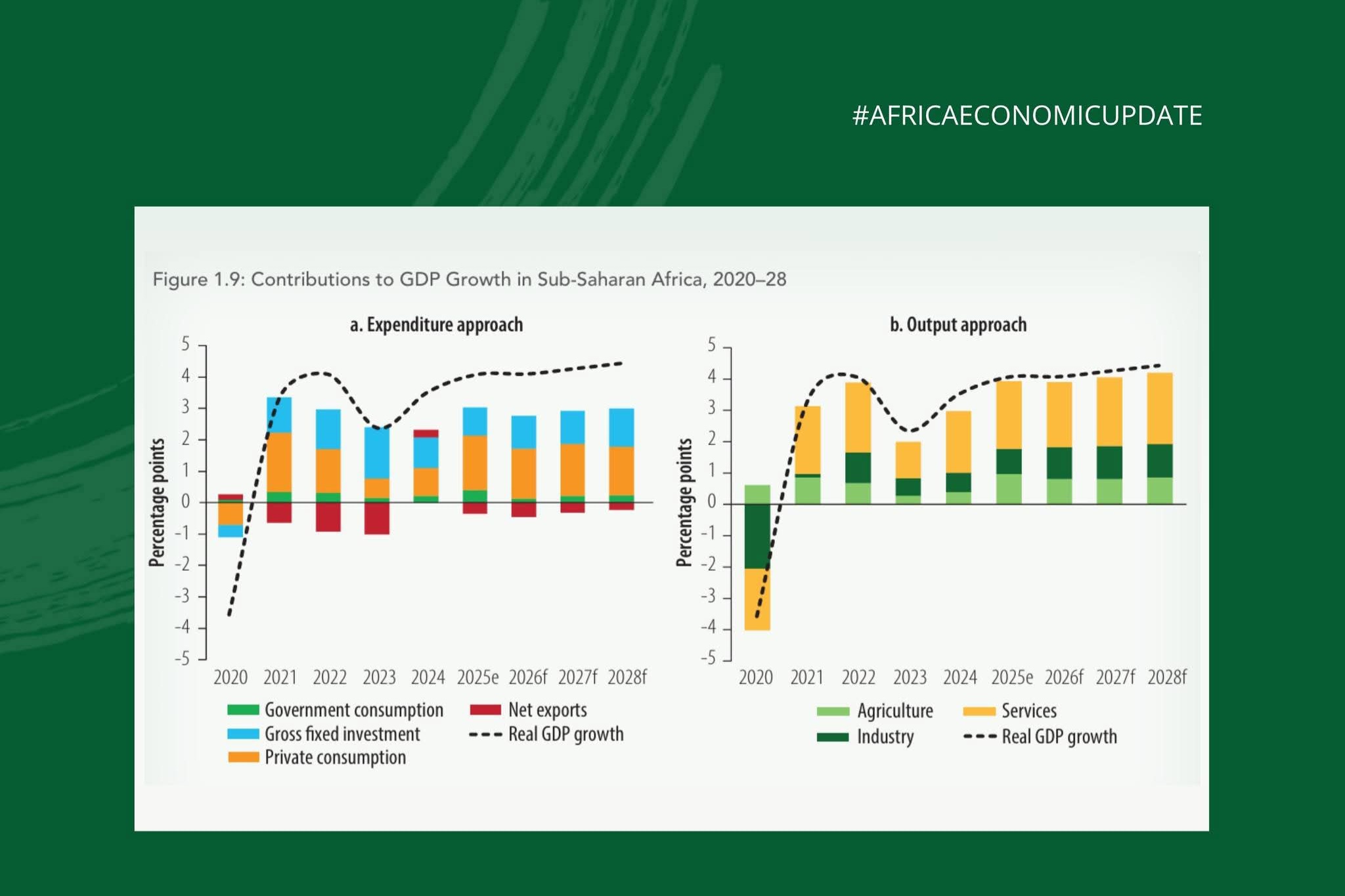
Economic growth in Sub-Saharan Africa is projected to hold steady at 4.1% in 2026, unchanged from 2025, but the recovery is losing momentum as global shocks and domestic constraints weigh on the region, the World Bank said in its latest Africa Economic Update.
The April 2026 report, released during the World Bank’s Spring Meetings, revised the 2026 forecast down by 0.3 percentage points from the 4.4% projected in October 2025.
The downgrade reflects spillovers from the Middle East conflict, higher energy and fertilizer prices, and tighter global financial conditions.
The region’s post-pandemic recovery has stalled, with growth plateauing at 4.1% for the second year running. Domestic demand continues to underpin activity, supported by private consumption and investment, and a weaker U.S. dollar has eased inflation in some countries.
But the gains are uneven. Rising fuel, food, and fertilizer prices are expected to push inflation back up to a median of 4.8% in 2026, after it fell to 3.7% in 2025.
The price hikes are hitting vulnerable households hardest, as they spend a larger share of income on food and energy.
According to the Report, high debt-service burdens are eroding fiscal space. Public debt across the region has exceeded $1.1 trillion, with debt servicing consuming a growing share of government revenues.
Debt-servicing costs have doubled from 9% of revenues in 2017 to about 18% in 2025, and roughly half of African countries are at high risk of or already in debt distress.
The Middle East conflict has intensified pressures by disrupting energy markets and raising import bills.

About one-fifth of global oil shipments pass through the Strait of Hormuz, and the U.S. Energy Information Administration has warned that elevated fuel prices could persist for months.
Investment flows and remittances are also at risk if the conflict weakens labor demand in the Middle East, where many African migrants work.
The World Bank urged governments to target scarce resources to protect the most vulnerable while maintaining macroeconomic stability. Controlling inflation and exercising prudent fiscal management are critical to navigating the current shock and positioning countries for a faster recovery.
The report also highlighted industrial policy as a tool to expand priority sectors and capture demand for African goods, from critical minerals to pharmaceuticals.
Success, it said, depends on realistic design, strong implementation capacity, and integration with infrastructure, skills, finance, and regional markets.
“Geopolitical risks—including the conflict in the Middle East, high debt-service burdens and long-standing structural constraints, continue to weigh on the region’s capacity to accelerate growth and create jobs,” said Andrew Dabalen, World Bank Chief Economist for Africa.