








An institution that seeks to reinvent itself cannot afford the luxury of superficial posturing or empty administrative declarations. True institutional rebirth demands a deliberate tearing down of old paradigms and the courageous construction of a framework rooted in purpose, discipline, and moral authority.
For generations, the relationship between the Ghanaian citizenry and the police was overshadowed by the ghost of colonial policing, a framework designed not to protect the citizen, but to project state power over the governed.
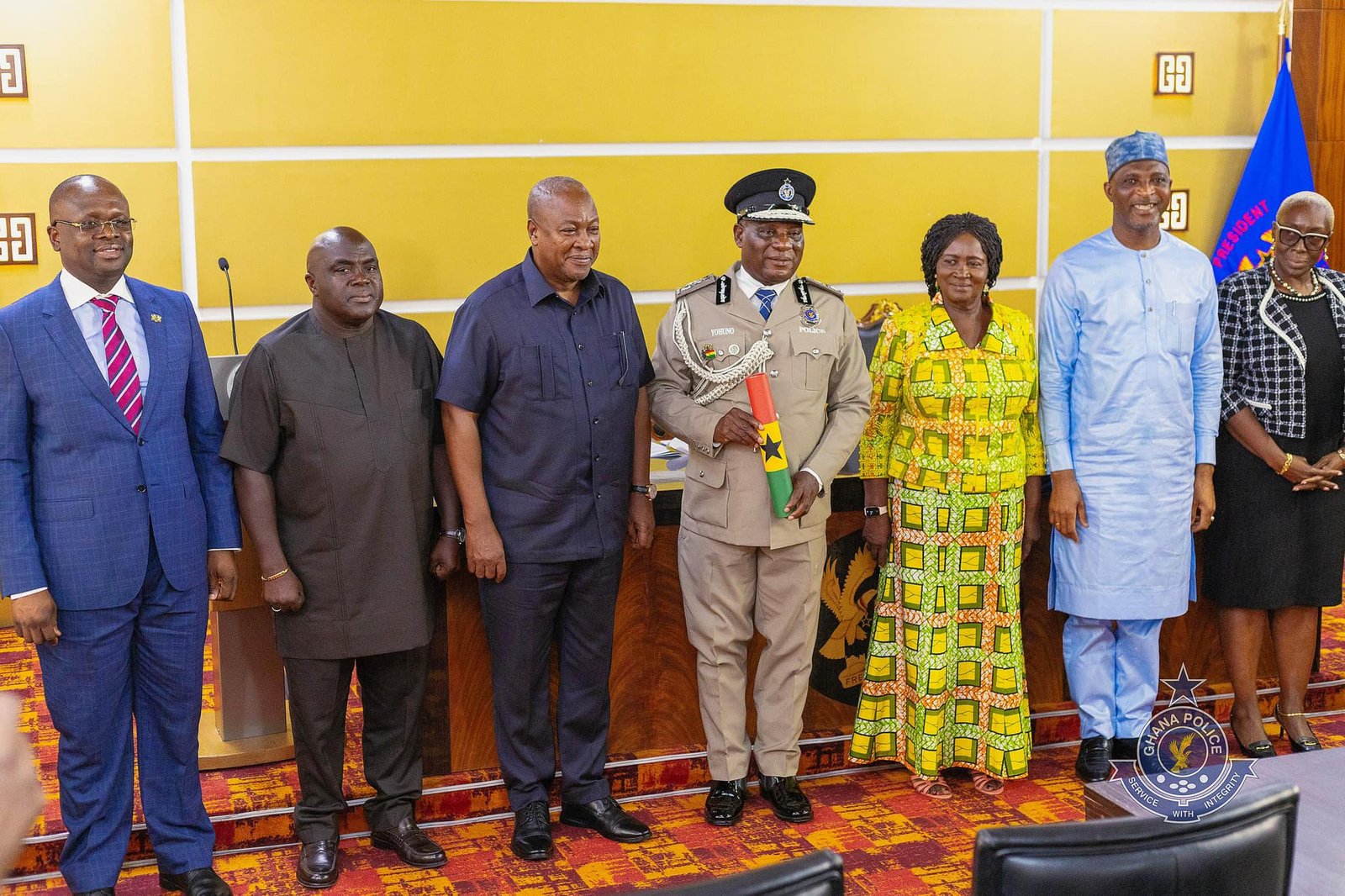
Today, beneath the surface of routine law enforcement, a fundamental structural and philosophical reconstruction led by the Inspector-General of Police is actively reshaping the Ghana Police Service.
This structural metamorphosis under the IGP’s stewardship goes far beyond tactical maneuvers or media visibility. It represents a systematic dismantling of the wall of division that once separated the uniform from the community.
Historically, the public viewed law enforcement through a lens of skepticism, conditioned by decades of arbitrary encounters and systemic friction. The ongoing reform agenda replaces this archaic posture with a doctrine of democratic policing, where authority is legitimate only when it commands respect rather than enforcing fear.
Power without public legitimacy is mere coercion, but power aligned with constitutional duty and civic respect becomes the anchor of public peace.
Central to the IGP’s structural overhaul is the understanding that operational efficiency is impossible without internal institutional justice. An officer whose daily existence is burdened by neglect, arbitrary career stagnation, and unaddressed psychological strain cannot reasonably be expected to exude empathy on the beat.

By introducing comprehensive welfare interventions, fair career advancement tracks, and structured psychological support, leadership has effectively restored professional pride to the service.
When the officer feels valued by the institution, that dignity naturally translates into professional courtesy, restraint, and decisive protection for the ordinary citizen.
Equally decisive is the shift from reactive policing to proactive, intelligence-driven dominance. In a rapidly evolving socio-economic landscape, criminals thrive on institutional sluggishness and structural voids. Modern law enforcement requires speed, intellectual rigor, and seamless technological integration.
Through strategic decentralization, enhanced visibility patrols, real-time command systems, and rapid response units, the Service has effectively reclaimed the public space from organized crime. The message to lawbreakers is clear and unequivocal: the state apparatus is no longer caught off guard; it is ahead of the curve.
Yet, structural reform achieves its ultimate purpose not in the boardrooms of police headquarters, but in the everyday experiences of ordinary Ghanaians. It is felt in the late-night journey of the commuter who no longer dreads the highway, in the trader whose livelihood is safeguarded from extortion, and in the firm assurance that the rule of law applies equally across every stratum of society.
When high-ranking figures and ordinary citizens alike are held to the same unyielding standard of accountability, the foundational pillar of constitutional democracy is reinforced, and public trust transitions from a vague ideal into a living reality.
Reforming an entrenched bureaucracy is inherently challenging, as old habits often resist the discipline of new standards.
True leadership, however, refuses to conceal internal flaws for the sake of institutional vanity. By rigorously enforcing internal discipline and exposing unethical conduct within the ranks, the IGP proves that the commitment to integrity is absolute. Self-correction is not an admission of institutional weakness; it is the ultimate proof of organizational maturity and moral clarity.
Ghana stands at a critical juncture in its democratic journey, where the stability of state institutions dictates the confidence of the nation.
The ongoing transformation of the Ghana Police Service offers a compelling template for public sector reform across the African continent. The uniform is shedding its legacy of intimidation to embrace its true mandate as a symbol of protection, justice, and civic partnership.
While the path to institutional perfection is an ongoing endeavor, the foundation has been firmly laid, and the Ghana Police Service is steadily cementing its place as an indispensable guardian of the Republic.
By RaymondAblorh