







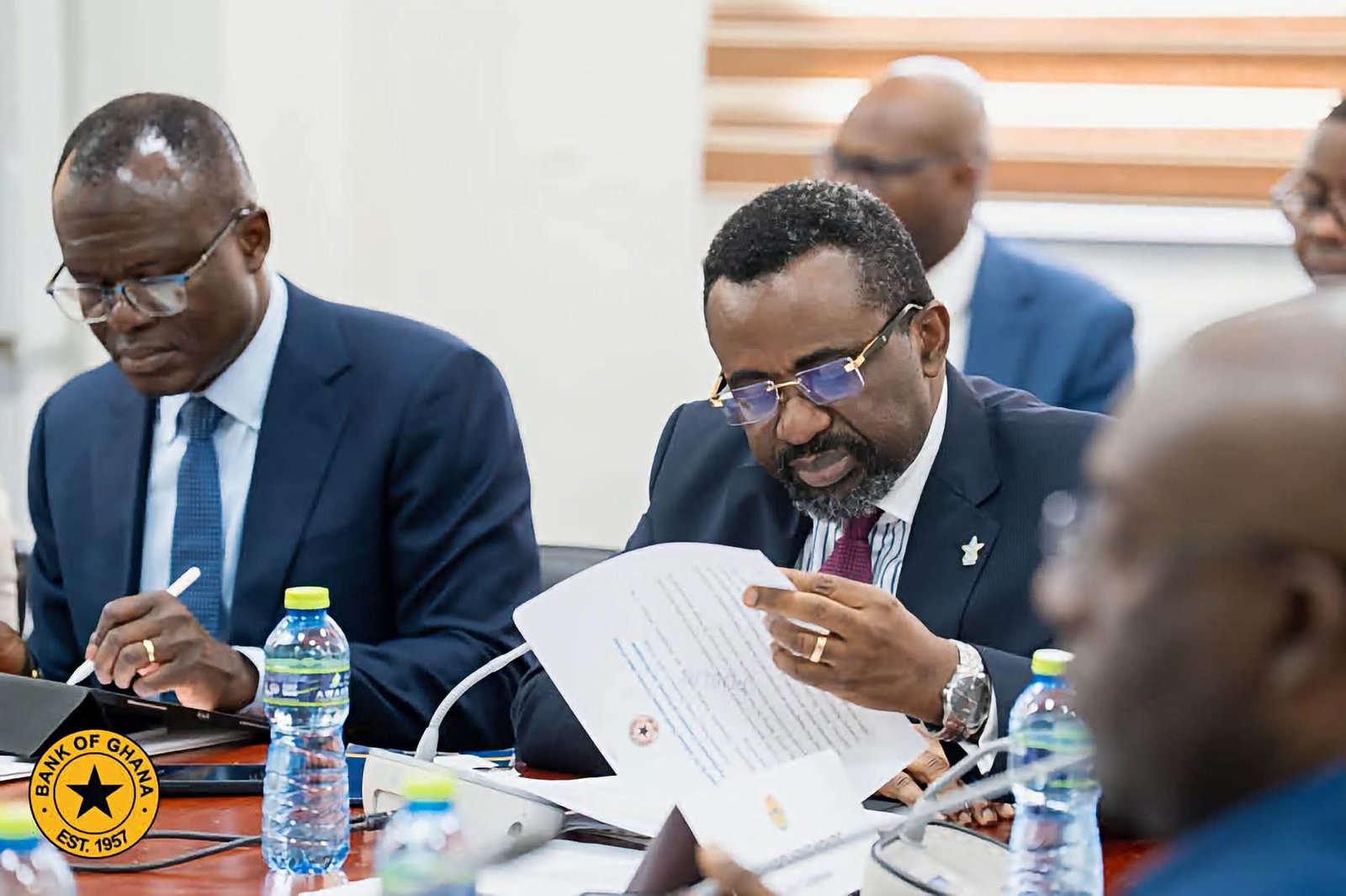
The Governor of the Bank of Ghana, Johnson Pandit Asiama on 6 November 2026, appeared before the Parliamentary Committee on Economy and Development to update Parliament on monetary policy and macroeconomic developments in the first half of 2026.
The Governor said the Policy Rate was cut from 18.0 per cent to 14.0 per cent in January and March, then held at 14.0 per cent in May, July and September to preserve stability amid rising global oil prices and domestic price pressures.
On growth and inflation, Dr Asiama said real GDP grew by 6.4 per cent in Q1 2026, while inflation fell to 3.2 per cent in March, then rose to 5.3 per cent in June, but remained below the 6-10 per cent target band.
Interest rates and credit conditions also improved. The average lending rate fell from 27.0 per cent to 15.6 per cent, while private sector credit grew by 41.2 per cent.
On the external sector, the Governor said Ghana recorded a trade surplus of US$8.81 billion and a current account surplus of US$5.1 billion. Reserves stood at US$12.94 billion, equivalent to 5 months of import cover.
In the banking sector, total assets rose by 30.7 per cent to GH¢502.4 billion. The Capital Adequacy Ratio stood at 20.4 per cent, while non-performing loans declined from 23.1 per cent to 16.1 per cent.

The Governor also outlined key reforms, including a uniform Cash Reserve Ratio of 20 per cent, a transparent and rules-based FX intervention framework, and the Ghana Accelerated National Reserve Accumulation Programme (GANRAP), which targets 15 months of import cover by 2028.
Governor Asiama reaffirmed the Bank’s commitment to price stability, transparency and accountability to Parliament and the Ghanaian people.