







The Minority Caucus has rejected the Bank of Ghana’s 2025 audited financial statements, claiming the central bank is “policy insolvent” and that its true operating loss is GH¢44 billion — not the GH¢15.6 billion headline figure.
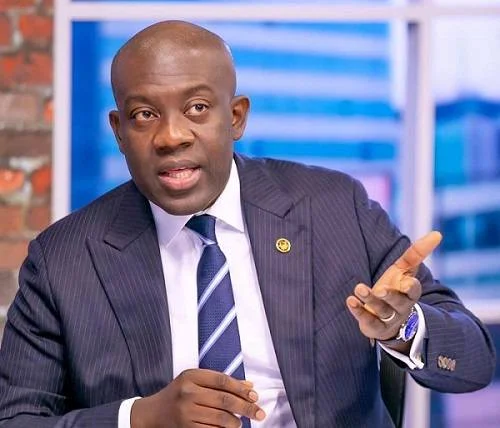
Addressing a press conference Sunday, Ranking Member on Finance Kojo Oppong Nkrumah said the Minority had “examined the accounts line by line, page by page, all 136 pages” since they were published on the BoG website late Thursday, April 30.
He accused government and the NDC of attempting “a PR spin about the gradual run-down of the bank” before the official release.
The Minority condemned what it called an “illegal” press conference held by “Non-MP members of the NDC communications team, joined some MPs” on the precincts of Parliament to announce the BoG accounts.
Citing Section 58(2) of the Bank of Ghana Act, Oppong Nkrumah said the law requires the Minister of Finance to submit the annual report to Parliament within one month, not a political party.
“The ACT does not say that the BOG should hand over the accounts to a political party to announce prior to the Minister presenting it to Parliament,” he said. “This politicisation of the BOG will create issues for the Independence and Creditability of the Bank going forward.”
The Minority said BoG’s claim of “strong policy solvency” on Page 7 of the accounts is “not true.”
Policy solvency, the Bank said, is measured as the difference between operating income and OMO interest costs. BoG reported GH¢22.2bn income vs GH¢16.7bn OMO cost, yielding a GH¢5.5bn surplus.
Oppong Nkrumah argued the GH¢22.2bn includes a GH¢9.6bn “net gain from sale of Gold Assets” disclosed in Note 9.
“The Bank of Ghana is not in the business of trading Gold. Selling off assets to generate income cannot be a sustainable way of running an entity,” he said.
Stripping out the gold sale, he said, leaves GH¢12.7bn income. “If you subtract the GH¢16.7 billion from the GH¢12.7 billion the BOG would have reported a deficit of GH¢4 billion.
Minus 4 billion Cedis puts the BOG in Policy Insolvency.”
“A central bank that needs gold sales to avoid policy insolvency is operating on borrowed time,” he added.
‘True loss is GH¢44bn’
The Minority disputed the GH¢15.6bn headline loss, pointing to Page 16 where BoG reports an additional GH¢19.3bn loss in Other Comprehensive Income.
“GHS 15.6 + GHS 19.3 = GHS 34.9 billion. And if you add back the sold Gold it is GHS 44 billion loss,” Oppong Nkrumah said.
He said BoG “moved GH¢19.3 billion of that into Other Comprehensive Income by changing the accounting Policy form IFRS to the BOG internal accounting Policy.”
KPMG’s audit note on Page 10 states the accounts are “prepared in accordance with the group’s own accounting policies” and “may not be suitable for another purpose.” The Directors admit on Page 4 that “recognition and measurement criteria as set out in IFRS… have not been applied.”
The Minority said BoG was recovering from 2022-2023 losses before 2025. Net loss narrowed from GH¢13.23bn in 2023 to GH¢9.49bn in 2024, but widened to GH¢15.63bn in 2025. Negative equity deepened by GH¢35bn to GH¢93.8bn.
“That is the reversal of recovery. And the only intervening variable… is the change of strategy at Cedi House,” Oppong Nkrumah said.
He cited three “self-inflicted” reversals:
Dynamic CRR: Abolishing the framework that tied reserves to lending pushed sterilisation bills from GH¢32.68bn to GH¢93.56bn. Cash interest on OMO rose from GH¢6.26bn to GH¢14.61bn.
Cedi-equivalent reserves: Reversing the rule in May 2025 released liquidity that banks redeposited with BoG at high interest. “The Bank of Ghana flooded the room and then paid commercial banks to mop it up.”
Gold purchase structure: New policy means BoG buys via GoldBod, which books profit while BoG records GH¢9bn loss on gold transactions.
The GH¢14.61bn interest paid to commercial banks, confirmed in Note 10, went into record bank profits of GH¢15bn, Oppong Nkrumah said.
“This is not monetary policy. This is a wealth transfer from the public balance sheet to private balance sheets,” he said, noting private-sector credit growth fell to 13.9% in 2025 from 28.8% in 2024.

“Every cedi paid to commercial banks through OMO is a cedi that did not fund a classroom, an apprenticeship, a youth skills programme.”
While acknowledging lower inflation at 5.4% and a stronger cedi, the Minority said “stability of numbers is not the same as stability of livelihoods.”
He cited tight liquidity, weak order books for manufacturers, high cost of living, unpaid teachers and nurses, and youth unemployment rising from 30% to 34%.
The Minority said it will outline “immediate measures” later this week to restore “true Policy Solvency.”
“The NDC in 2023 claimed that the Bank of Ghana was a crime scene… Today with the worsened situation and using the NDCs own standards, what should be said now?” Oppong Nkrumah asked.