






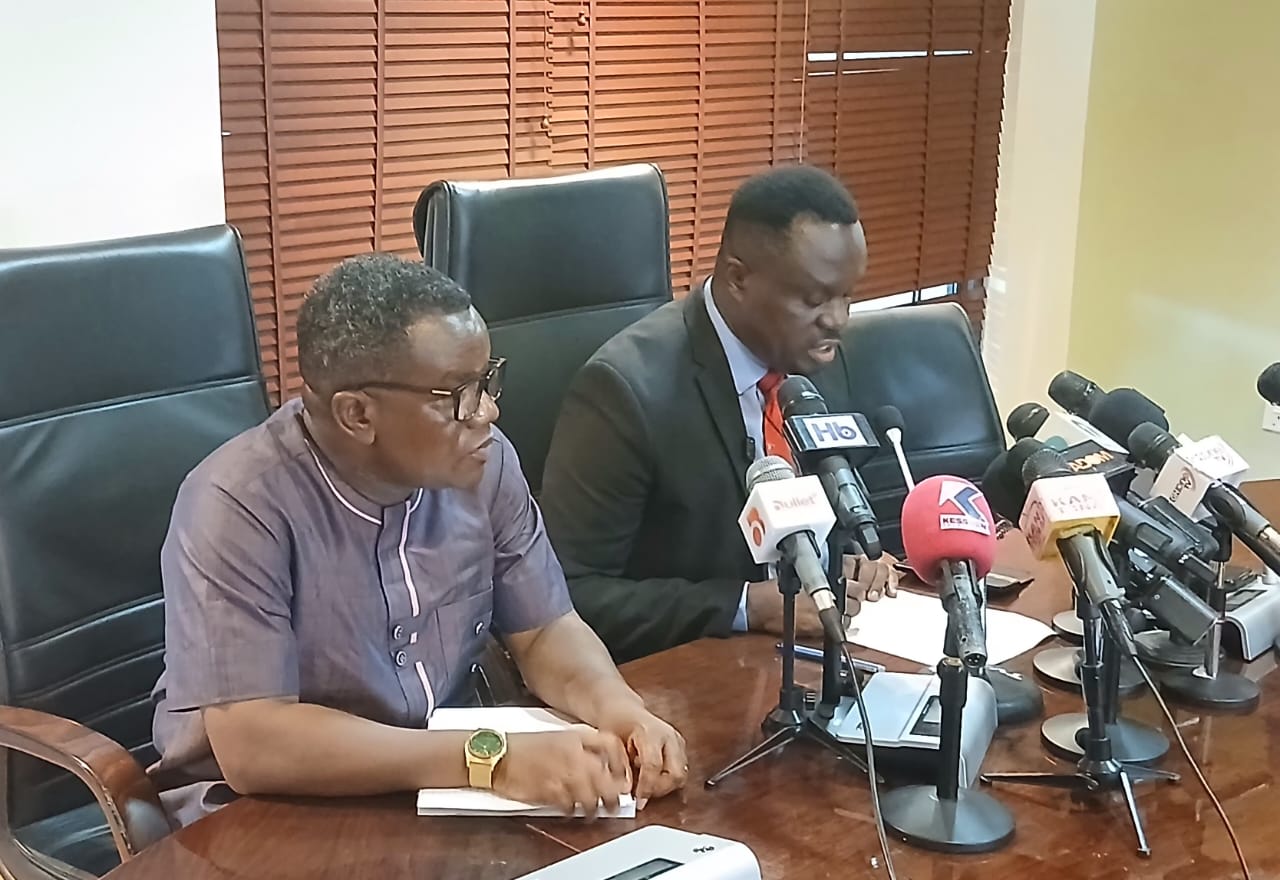
The Member of Parliament for Amenfi West and Chairman of the Parliamentary Committee on Economy and Development, Dr. Eric Afful has defended the Bank of Ghana’s (BoG) 2025 financial results amid public concerns over its reported losses and negative equity position.
The statement contextualizes the bank’s financial outcomes within Ghana’s challenging macroeconomic environment, emphasizing that central bank losses are often a reflection of necessary policy interventions rather than operational failure. Notably, the BoG reported a net loss of GH¢15.6 billion in 2025, alongside an OCI charge of GH¢19.32 billion and a negative equity of GH¢96.3 billion.
Dr. Afful said “as the Majority side of the Committee on Economy and Development, we consider it necessary, in the interest of transparency and informed public discourse, to place these results within their proper economic and policy context.
Accordingly, “at face value, the Bank reported a net loss of GH¢15.6 billion in 2025, an Other Comprehensive Income (OCI) charge of GH¢19.32 billion, and a negative equity position of GH¢96.3 billion. While these figures are significant, they must not be interpreted through the narrow lens of commercial banking. Central banking is fundamentally a public policy function, and its financial outcomes often reflect the cost of stabilizing the economy”.
To fully appreciate The MP mentioned “the 2025 results, one must consider the recent historical context. Between 2022 – 2024, the Bank of Ghana recorded cumulative losses of approximately GH¢80.85 billion. For instance, in 2022, the Bank incurred a loss of GH¢60.81 billion, GH¢10.55 billion in 2023, and GH¢9.49 billion in 2024. This period coincided with one of the most severe macroeconomic crises in Ghana’s recent history”.
This situation is rooted in a series of accumulated losses from 2022 to 2024, totaling approximately GH¢80.85 billion, driven by a severe economic crisis marked by hyperinflation reaching 54.1% in 2022, cedi depreciation, and declining international reserves. During this period, the bank’s negative equity worsened, reaching over GH¢61 billion by 2024.
However, the statement highlights significant macroeconomic improvements in 2025, including inflation dropping sharply to 5.4%, further to 3.2% by March 2026, and the cedi appreciating by over 40%, reversing prior instability. Gross international reserves increased to about US$13 billion, covering nearly six months of imports, with projections to reach 15 months under the government’s Reserves Accumulation Program. Economic growth also accelerated, with GDP expanding by 6%, and non-oil GDP growing at nearly 8%.

The figures reflect deliberate policy measures, such as the implementation of the Domestic Debt Exchange Programme (DDEP), which reduced interest income but was essential for debt sustainability, and aggressive open market operations to control inflation. These interventions incurred costs, including interest expenses and valuation losses on foreign assets, which contributed to the reported financial losses.
The MPs emphasized that these losses do not impair the Bank’s operational capacity or its core mandate of maintaining price stability, financial stability, and managing reserves however, “Economic growth also strengthened, with GDP expanding by about 6.0 percent in 2025 and non-oil GDP growth reaching 7.8 percent. The size of the economy increased to approximately US$113 billion, with per capita income rising to about US$3,193”.
He clarified that negative equity is an accounting condition and does not imply insolvency, citing global examples where major central banks experienced similar financial outcomes during periods of aggressive policy tightening.
Looking forward, the committee members expressed confidence that these costs will diminish over time as liquidity conditions stabilize, and the government’s commitment to recapitalizing the bank will strengthen its balance sheet.
According to him, the 2025 results should be viewed as the cost of restoring economic stability, rebuilding confidence, and securing Ghana’s future, rather than a failure.