








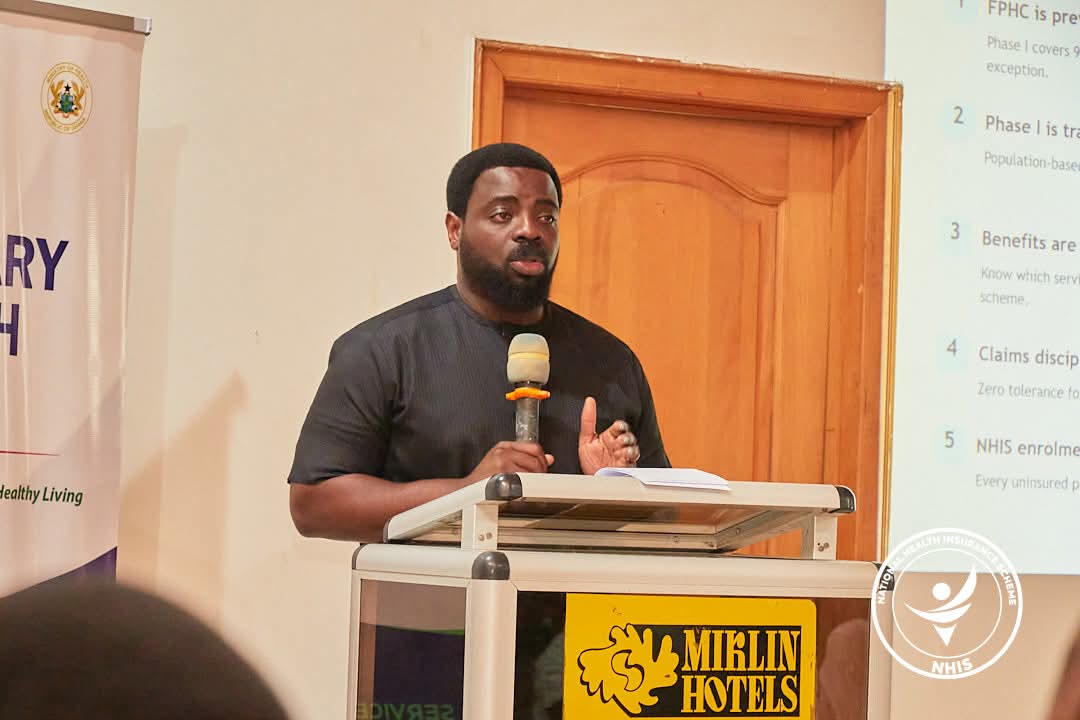
The National Health Insurance Authority (NHIA) has extended its nationwide staff sensitisation exercise on Ghana’s Free Primary Health Care (FPHC) policy to staff from the Ashanti and Western North Regions, with a joint session held in Kumasi.
The exercise forms part of the Authority’s preparations toward the rollout of the policy, aimed at ensuring a uniform understanding among staff as key implementers.
The first phase of the policy is expected to be rolled out in April 2026.
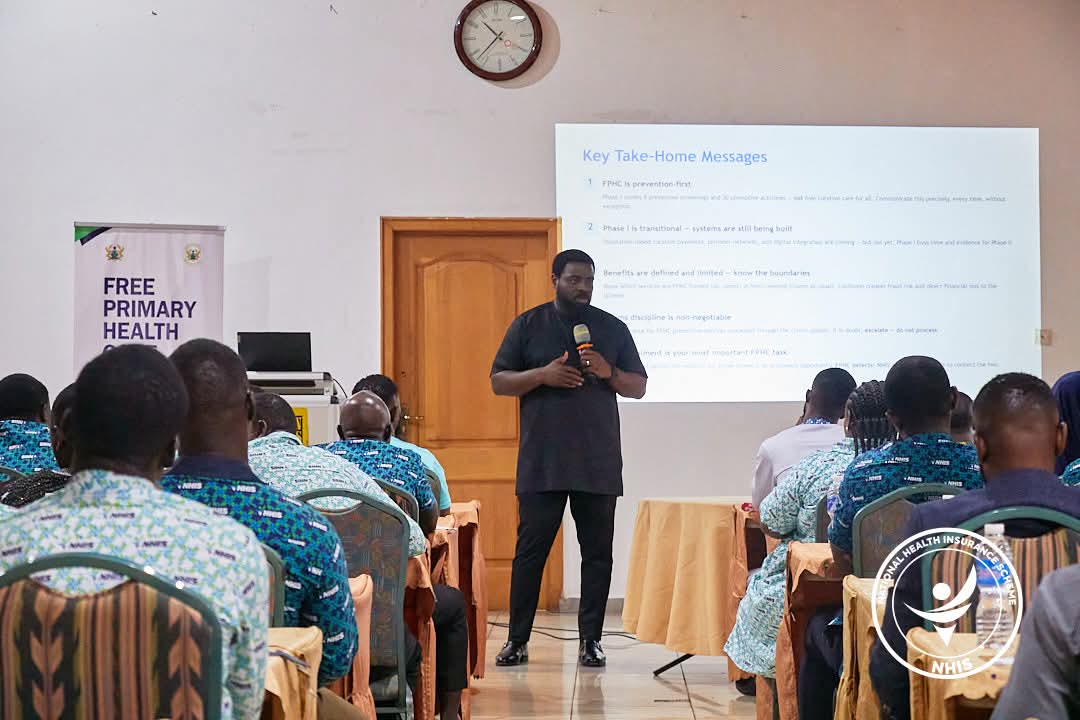
As with previous engagements in Accra and Tamale, the Kumasi session featured interactive discussions and presentations on the policy framework, implementation strategy, digital systems, and the monitoring and evaluation framework.
The Deputy Chief Executive Officer in charge of Operations at the NHIA, Kwesi Senanu Djokoto, emphasised that the FPHC policy aligns with global health trends focused on expanding access to care for vulnerable populations, particularly in the drive towards Universal Health Coverage (UHC).
He noted that Ghana is demonstrating leadership through bold health sector reforms under the “Accra Reset” agenda led by President John Dramani Mahama, positioning the country as a model for health system transformation in Africa.
Dr Djokoto highlighted strong leadership and institutional alignment as critical to the policy’s success, commending the NHIA Chief Executive, Dr Victor Bampoe, for providing strategic direction that has enabled nationwide staff engagement and preparation.

He stressed that staff must understand and own the policy to effectively deliver it.
“We cannot give what we do not have. We must first understand and own the policy before we can effectively deliver it,” he said, urging staff to confidently articulate and support its implementation.
He added that while no policy starts perfectly, early identification of gaps and timely responses would be key to success. He also pointed to countries such as Singapore, where sustained investment in preventive healthcare has improved outcomes and reduced long-term costs.
Dr Djokoto further highlighted ongoing efforts to strengthen the National Health Insurance Scheme (NHIS), including tariff adjustments, measures to curb illegal payments, and improvements in claims payments and membership coverage, which he said provide a strong foundation for the rollout.
“I am certain that with your commitment and dedication, we will succeed. Go out there and champion this policy,” he concluded.
Policy highlights

The Acting Director of Operations at NHIA, Mariam Musah, described the FPHC policy as a flagship government reform aimed at reorienting service delivery and health financing towards prevention, equity, and sustainability.
She said the policy envisions a Ghana where all residents have equitable access to a defined package of preventive and promotive healthcare services, free at the point of use.
She, however, noted that either the Ghana Card or an NHIS card would be required for identification before accessing the defined FPHC package, but emphasised that active NHIS membership becomes essential once a patient is referred beyond the primary care level.
“FPHC detects the problem; NHIS pays for the treatment,” she stressed, underscoring the need to enrol clients at every FPHC touchpoint to protect them from financial risk.
She added that the reform addresses long-standing challenges such as late presentation of illness, rising non-communicable diseases, and high out-of-pocket payments.
“For too long, our health system has been dominated by curative, hospital-based services. FPHC shifts the focus to prevention and health promotion,” she stated.
Ms Musah explained that the policy guarantees free preventive and promotive services, including screenings for hypertension, diabetes, mental health, and BMI, at CHPS compounds, health kiosks, health centres, and public health units of polyclinics for both insured and uninsured persons.
The Director of Corporate Affairs, Oswald Essuah-Mensah, stressed the importance of effective communication and stakeholder engagement in the policy’s success.
He outlined a multi-channel communication strategy involving television, radio, social media, community outreach, and engagements in markets, churches, and mosques.
Success, he said, would be measured by improved public understanding, increased uptake of preventive services, and reduced out-of-pocket expenditure.
“The goal is to keep Ghanaians healthy through prevention and health promotion, rather than treating illnesses at advanced stages,” he said.
Other presentations were delivered by Stephen Bewong on digital innovations, including the One-Time Attendance Code (OTAC) system, and Suleymana Abass on the implementation tracking framework.