







The Minority Caucus, led by Hon. Kennedy Osei Nyarko, has once again mounted the high altar of the Parliament Chamber Press Foyer to deliver a sermon on “Roads and Transport.”
It was a performance rich in theatrical indignation but bankrupt in constitutional honesty. To the casual observer, their words might sound like a clarion call for the masses; to the discerning citizen, however, it is a transparent attempt to weaponize administrative complexities for narrow political gain.
The Ranking Member’s condemnation of the arrest of commercial drivers is a masterclass in moral double-think. To argue that a “liberalized economy” grants a license for the arbitrary exploitation of the vulnerable is a perversion of the very market principles they claim to defend.
We must ask: where is the “humanity” in defending the predator over the prey? The Minority speaks of “high-handedness” by task forces, yet they remain silent on the high-handedness of the driver who doubles a fare on a rainy Tuesday, leaving the Ghanaian worker stranded at the roadside.
A state that cannot enforce its own transport regulations is not a “liberal” state; it is a failed one. Law and order are the twin pillars of a functioning Republic; to suggest that the police should look away while the public is fleeced is to advocate for a descent into transactional anarchy.
The Minority’s obsession with the National Roads Authority 2024 Act (Act 1118) is a classic case of prioritizing the “altar of bureaucracy” over the “temple of service.”
They shout for immediate implementation, ignoring the forensic reality that a premature rollout of an administrative skeleton without the necessary financial sinews is a recipe for institutional paralysis.
Constitutional clarity demands that we recognize the Executive’s duty to ensure that when an Authority is birthed, it is equipped to walk.
To demand the instant activation of Act 1118 while simultaneously complaining about contractor debt is a logical contradiction of the highest order. You cannot build a new house while the current roof is leaking and the carpenter remains unpaid.
The Minority’s critique of the “political wish list” for roads is a breathtaking display of selective amnesia.
They speak of the Accra-Kumasi corridor as if it were a forgotten wasteland, conveniently ignoring the massive bypasses and dualization projects currently turning the Nsawam-Konongo stretch from a death trap into a modern artery of commerce.

Infrastructure is not a magic trick; it is a massive, multi-year engineering undertaking. To describe the strategic prioritization of national corridors as a “political wish list” is to insult the intelligence of every engineer and contractor currently on-site.
The Minority’s rhetoric suggests that if every road is not built at once, then no road is being built at all. This is not “oversight”; it is “obstructionism” masquerading as accountability.
The lamentation over the Metro Mass Transit (MMT) fleet is a cynical use of data to mask a deeper truth. The decline of the national fleet is not a recent phenomenon but the cumulative result of decades of structural rot, rot that the Minority’s own kin helped cultivate.
The current administration’s shift toward a more sustainable, private-sector-integrated model for urban transport is a necessary evolution, not a “collapse.” We are moving from a state-subsidized inefficiency to a streamlined, digital-integrated transport future.
Ultimately, the Minority’s press conference was an exercise in juxtaposition, pitting the struggles of the poor against the actions of the state to ignite a fire they have no intention of putting out.
They offer no alternative budget, no fiscal roadmap, and no credible policy framework. They offer only noise.
Governance is the art of the possible within the constraints of the real. It is easy to stand in a foyer and demand everything; it is difficult to sit in a cabinet room and decide what can be achieved with what is left.
The Minority has chosen the path of the critic because they fear the responsibility of the creator.
We refuse to be led into a valley of despair by those who provided the very map that brought us there. The work continues. The roads are being built. The law will be enforced. The Republic shall prevail.
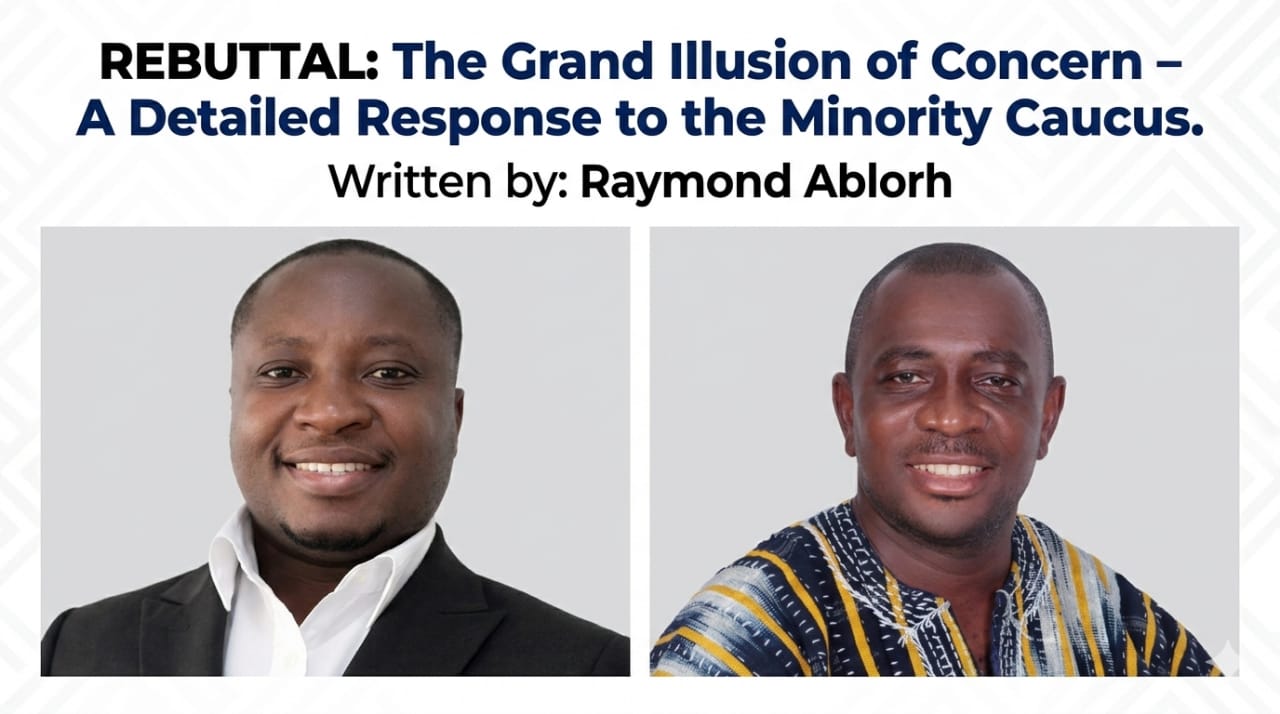
The author, Raymond Ablorh is a highly revered professional Ghanaian Journalist and Strategic Communications Consultant with over 25 years of mass communication experience. He started writing for Daily Graphic in December, 2000 before expanding his scope on both local and international media landscape. After serving the global media development giant Deutsche Welle (DW) in 2013/14, he joined Telco giant Airtel Ghana as their Communication Manager from where he became a strategic communication consultant.
By Raymond Ablorh