







Ghana’s economy grew by 6.0% in the second quarter of 2026, driven largely by strong performances in the services sector, information and communication technology (ICT), transport, and a significant increase in investment.
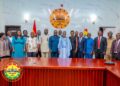
Government Statistician, Dr. Alhassan Iddrisu, disclosed this on Wednesday, September 9, 2026, when he presented the Ghana Statistical Service’s (GSS) 2026 Q2 Gross Domestic Product (GDP) Estimates and June 2026 Monthly Indicator of Economic Growth (MIEG).
Growth Remains Strong but Moderates
According to Dr. Iddrisu, although the economy maintained strong growth, the 6.0% expansion represented a moderation from the 6.6% recorded in the second quarter of 2025, a decline of 0.6 percentage points.
Real GDP increased from GH¢48.4 billion in Q2 2025 to GH¢51.3 billion in Q2 2026, while nominal GDP rose from GH¢334.1 billion to GH¢372.1 billion, representing an 11.4% year-on-year increase.
Services Remain the Main Growth Driver
The services sector remained the biggest contributor to Ghana’s economic expansion, growing by 8.0% during the quarter.
The sector accounted for 57.6% of total GDP growth, although its growth rate was lower than the 9.5% recorded in Q2 2025.
Within the sector, the Information and Communication subsector recorded the strongest performance, expanding by 30.9%, compared with 21.3% a year earlier.
Dr. Iddrisu said ICT alone contributed 41.5% of overall GDP growth, making it the single largest driver of the economy’s performance during the quarter.
Transport and Storage also recorded significant growth of 14.9%, while Trade expanded by 5.9%.
However, some services activities recorded contractions. Accommodation and Food Services declined by 7.8%, while Public Administration and Defence and Education each contracted by 4.7%.
Real Estate also recorded a 2.6% contraction.
Industrial Sector Strengthens
Dr. Iddrisu said the industrial sector strengthened during the quarter, growing by 4.3%, compared with 2.4% in Q2 2025.
The improvement was partly attributed to a strong rebound in oil and gas production, which expanded by 22.4%, reversing a 29.0% contraction recorded in the same quarter of the previous year.
Manufacturing recorded growth of 6.6%, while Electricity expanded by 5.1%. Mining and Quarrying also grew by 2.6%.
Overall, industry contributed 23.5% to GDP growth in Q2 2026.
However, Construction slowed from 6.5% to 4.4%, while Water and Sewerage contracted by 0.6%.
Agriculture Growth Slows
Agriculture expanded by 3.9%, significantly lower than the 7.1% recorded in Q2 2025.
Dr. Iddrisu said the sector’s performance was weighed down by a sharp contraction in Fishing, which declined by 24.7%.
Crops grew by 5.2%, while Livestock recorded growth of 5.9%.
Forestry and Logging emerged as the fastest-growing agricultural subsector, expanding by 10.7%.
Investment Surges 53%
On the expenditure side, Dr. Iddrisu highlighted a significant surge in investment activity.
Gross capital formation, or investment, increased by an impressive 53.0% in Q2 2026, compared with 8.6% a year earlier.
Domestic demand also strengthened, growing by 11.2%, while Gross Domestic Expenditure expanded by 6.0%.
However, consumption growth slowed sharply to 2.1%, compared with 11.4% in Q2 2025.
Monthly Growth Gains Momentum
The monthly growth rate also improved progressively during the quarter, rising from 5.5% in April to 6.0% in May and 6.5% in June.
Services led the June performance with 10.8% growth, followed by Agriculture at 6.4% and Industry at 4.7%.
ICT, Manufacturing and Transport Offer Opportunities
Dr. Iddrisu said the latest figures point to an economy maintaining strong momentum, although growth remains concentrated in selected sectors.
He identified ICT, transport, manufacturing, crops and productive services as areas generating significant momentum and potentially offering opportunities for businesses and investors.
At the same time, he noted the need for targeted interventions in sectors experiencing contractions, including fishing, accommodation and food services, real estate, education, public administration and water services.
Ghana Records 6.2% Growth in First Half
The Q2 performance leaves Ghana with a 6.2% growth rate for the first half of 2026, underpinned by services, ICT, investment and an improving industrial sector.
However, weaknesses in agriculture and selected services remain areas requiring policy attention.
The latest figures suggest that while Ghana’s headline growth remains strong, the broader measure of economic progress will depend on whether the expansion translates into more jobs, higher incomes, stronger public and private services, and improved living standards.