






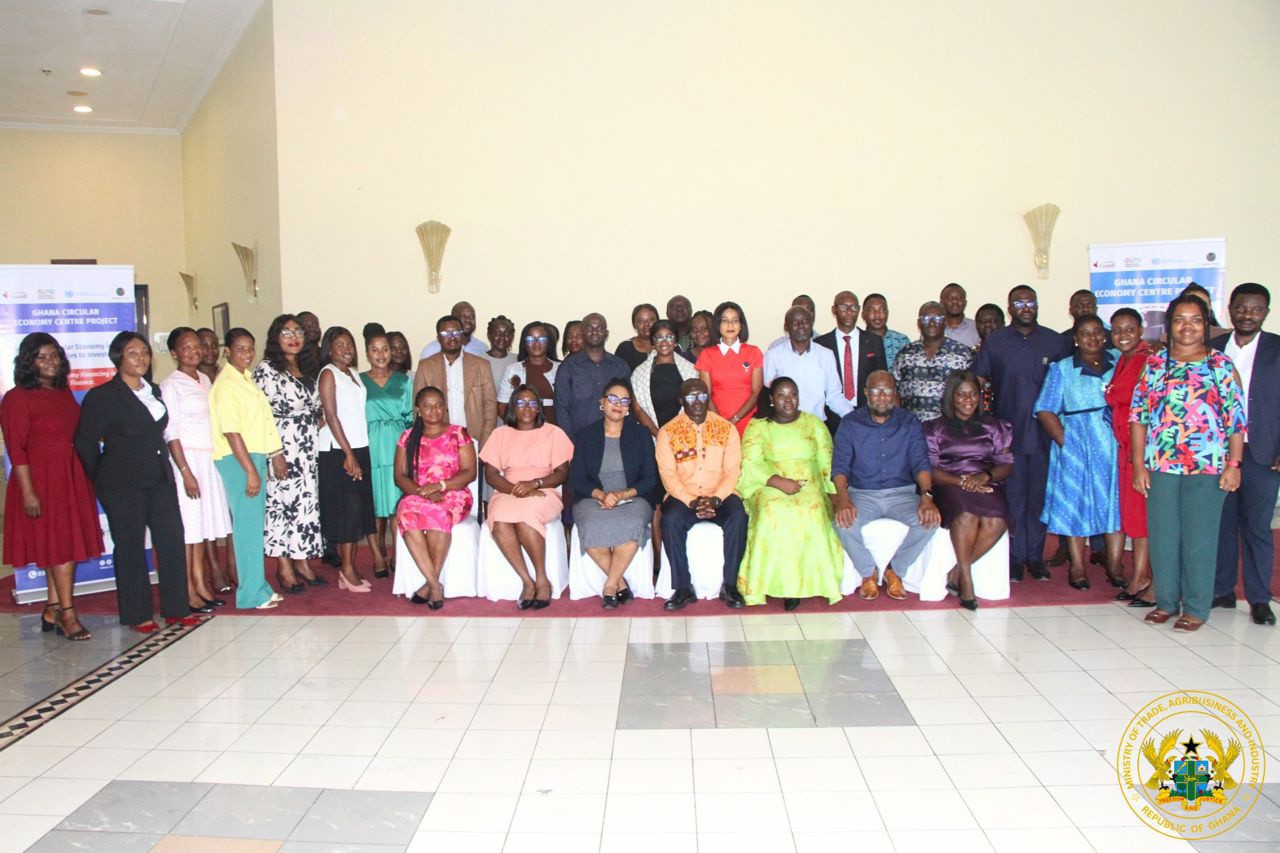
A four-day capacity-building workshop on circular economy principles has commenced on Tuesday, 7th April, 2026 in Accra, bringing together key stakeholders from government, development partners, and industry to strengthen Ghana’s transition toward sustainable production systems.
The Training of Trainers programme, organized under the Ghana Circular Economy Centre (GCEC) Project with support from the United Nations Industrial Development Organization (UNIDO) and Global Affairs Canada, aims to equip participants with the knowledge and tools to champion circular economy practices across sectors.
Delivering the opening remarks, the Director of SME Development at the Ministry of Trade, Agribusiness and Industry, Madam Cynthia Djokoto, , described the training as a critical milestone in Ghana’s industrial transformation agenda. She noted that the initiative reflects the Ministry’s commitment to promote sustainable and inclusive economic growth.
She commended UNIDO for its continued partnership, describing its support as a catalyst for Ghana’s transition from a traditional “take–make–dispose” model to a more sustainable circular economy. According to her, the training marks the culmination of a series of strategic engagements, including a consultative meeting in October 2025 and a high-level stakeholder session in February 2026.
Adding a technical perspective to the programme Dr. Halid Abu-Bakar, UNIDO Circular Economy Expert led participants through a series of structured sessions designed to build both conceptual understanding and practical application of circular economy principles.
He began with an overview of the programme’s objectives, success indicators, and agenda, encouraging participants to define personal learning goals and commit to active engagement throughout the training. Through interactive tools such as Mentimeter and pre-training surveys, he introduced participants to global sustainability challenges, including planetary overshoot, while drawing connections to Ghana’s linear consumption patterns and emerging environmental pressures.
Dr. Abu-Bakar further guided participants through the concept of triple-bottom-line externalities highlighting the social, environmental, and economic costs of current production systems, including health risks, inequality, ecosystem degradation, and financial losses. Participants were tasked with identifying and articulating these impacts within the Ghanaian context.
A key component of his sessions focused on narrative-building, where participants were trained to communicate circular economy concepts effectively without relying on technical jargon. He stressed the importance of framing urgency and localizing examples, enabling participants to craft compelling messages that resonate with policymakers, businesses, and communities.
As part of the practical exercises, participants developed short presentations explaining the relevance of circular economy (“Why CE”) in Ghana, receiving peer feedback and refining their messages into teaching-ready materials. Post-training surveys were also conducted to assess knowledge gains and build confidence in delivering the concepts.
The sessions are expected to create a multiplier effect, equipping participants to serve as trainers and advocates within their institutions and across the MSME ecosystem.

ADVERTISEMENT