








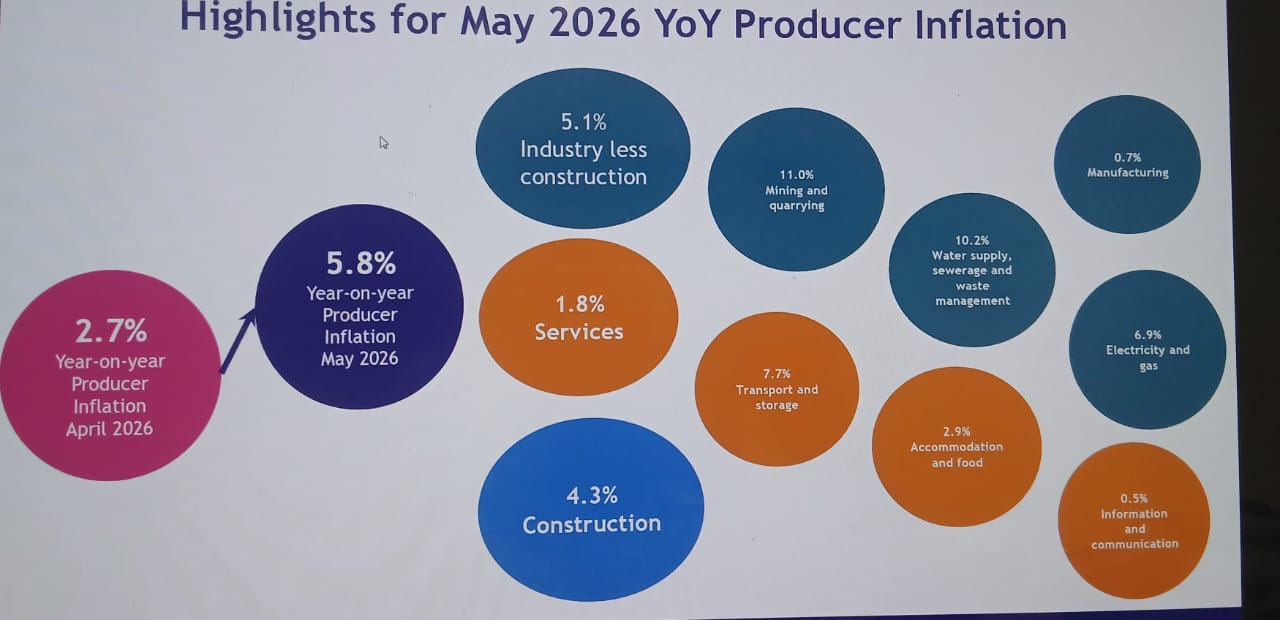
Ghana’s Producer Price Inflation (PPI) experienced a notable increase in May 2026, reaching 5.8% — up from 2.7% in April. This represents a significant rise of 3.1 percentage points, reflecting growing inflationary pressures within the country’s production sector.
Despite the year-on-year surge, there was a short-term easing in price pressures on a monthly basis, with PPI decreasing by 1.4% from April to May.
The key drivers behind the rising inflation include substantial increases in the Mining and Quarrying sector, which accounts for 43.7% of the PPI weight. This sector saw its inflation rate jump from 5.6% in April to 11.0% in May, significantly contributing to the overall increase.
Meanwhile, the Manufacturing sector, representing 35% of the PPI, moved from a deflationary -0.7% to a positive 0.7%, indicating a turnaround in prices. Additionally, the Transport and Storage sector, which had previously experienced a decline of -6.6%, reversed course to register a 7.7% increase, signaling a reversal of earlier downward price trends.
Analysts suggest that these sectoral shifts may reflect evolving economic conditions and could influence future inflation and monetary policy decisions in Ghana.

The Producer Price Index (PPI) measures the average change in the selling price of goods and services as received by domestic producers over time.
PPI computation is based on a fixed basket of products, using price data for 2,639 items collected each month from 603 domestic producers, with March 2020 to February 2021 = 100 as the base period.
The Prices collected are known as factory gate prices, which are the prices firms receive for selling products or offering services.