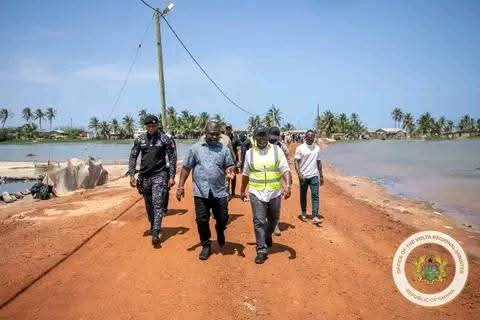







When Ghanaians hear the word galamsey, many of us immediately picture destroyed farmlands, brown rivers, abandoned pits, and communities struggling with the damage left behind by illegal mining. We see the scars clearly. The rivers change colour. The land is scared. Farmers lose their livelihoods. Communities feel the impact.
But there is another form of resource abuse happening quietly beneath our feet. It does not always leave muddy rivers behind. It does not always make headlines. Its damage may not be seen immediately. Yet, if we ignore it, it can threaten our homes, schools, farms, businesses, health, and national water security.
I call it Groundwater Galamsey.
Groundwater Galamsey is the uncontrolled, unscientific, and poorly documented drilling of boreholes without proper hydrogeological investigation, professional supervision, water quality testing, pumping tests, borehole completion records, or submission of data for national planning. It happens when anyone with access to a drilling rig enters a community, drills into the ground, collects payment, and leaves without asking the most important question: What exactly have we done to this hidden water resource?
Groundwater may be hidden, but it is not unlimited. It may lie beneath private land, but it is not only a private matter.
It is part of Ghana’s national water security system. Every borehole taps into a larger natural system, and when that system is misused, the consequences do not stop at one household or one compound.
Groundwater is not guesswork

To many people, a borehole is simply a deep hole in the ground that brings water. But to a hydrogeologist, a borehole is much more than that. It is a carefully designed access point into an aquifer. An aquifer is a rock formation or geological material that can store and transmit groundwater.
In some parts of Ghana, groundwater is found in weathered rocks. In other places, it occurs in fractures within hard crystalline rocks.
In coastal areas, it may be stored in sandy or sedimentary layers, but these same areas may also be vulnerable to salinity and seawater intrusion when groundwater is over-pumped.
This means that groundwater does not occur by chance. It is controlled by the nature of the rocks, the presence of fractures, the depth of weathering, rainfall, recharge, topography, land use, and the number of boreholes already drawing water nearby.
So, drilling a borehole should never be a matter of guesswork, convenience, or “bring the rig and let us try.” It should be based on science. A borehole drilled without proper investigation can fail. It may produce very little water. It may work for a few months and then decline.
It may interfere with nearby boreholes. It may be drilled in a place where contamination can easily enter. It may expose families to health risks. Worse still, it may provide no useful data to help Ghana understand and manage its groundwater resources.
Owning a rig is not the same as understanding groundwater
We need to speak frankly about this. Borehole drilling has become a fast-growing business in Ghana. Many homes, churches, schools, hotels, factories, farms, and real estate developers now depend on boreholes because of unreliable public water supply or growing water demand.
This demand has created opportunities, and there is nothing wrong with that. Private drilling companies are helping many people access water. But the problem begins when drilling becomes only a commercial activity, without scientific responsibility. A person may own a drilling rig but may not understand groundwater.
A company may know how to drill a hole but may not know how to interpret the geology, identify the aquifer, design the borehole properly, protect it from contamination, conduct a pumping test, estimate a safe pumping rate, or prepare a borehole completion report.
Drilling is not just a mechanical activity. It is a scientific and engineering process. It requires knowledge of hydrogeology, geophysics, drilling methods, borehole construction, water quality, public health, and environmental protection.
Without these, borehole drilling becomes a gamble. And when many people gamble with the same hidden resource, the result can become a national crisis.
The danger is not always immediate
One reason Groundwater Galamsey is so dangerous is that its effects may not show immediately.
A poorly sited or poorly constructed borehole may produce clear water at first. The household may be happy. A school may celebrate. A hotel or factory may reduce its dependence on public water supply.
A community may feel relieved. But beneath the surface, problems may already be developing. If the borehole is not properly sealed, dirty surface water can enter it. If it is drilled too close to a septic tank, pit latrine, refuse dump, drainage channel, cemetery, fuel station, polluted stream, or mining area, contamination can slowly reach the water. If no pumping test is done, the pump installed may be too strong for the aquifer.
If many boreholes are drilled too close together, they may begin competing for the same groundwater. If no water-quality test is done, people may drink water that looks clean but contains harmful substances.
This is why we must stop assuming that clear water is safe water.
Some contaminants cannot be seen with the eye. Nitrate, fluoride, arsenic, lead, mercury, excessive salinity, iron, manganese, and microbial contamination may be present even when water looks clean. In some cases, the health effects may appear only after years of exposure. Water quality testing should therefore not be treated as optional. A borehole is not safe simply because water flows from it.
Every borehole must tell a story
Every properly drilled borehole should leave behind a scientific record. That record is not paperwork for paperwork’s sake. It is the story of what was found underground.
A proper borehole record should tell us the location of the borehole, the depth drilled, the rock types encountered, the depth at which water was struck, the static water level, the pumping water level, the drawdown, the recovery, the yield, and the recommended pumping rate. It should also include water-quality results and construction details such as casing, screen, gravel pack, sanitary seal, and borehole protection.
These are not small details. They are national water data. When boreholes are drilled without records, Ghana loses valuable information. We lose data that could help us map aquifers, identify productive groundwater zones, understand water quality patterns, monitor groundwater levels, assess climate-change impacts, detect salinity risks, guide district planning, and protect communities from contamination.
A country that drills thousands of boreholes without collecting data is like a person reading an important book and tearing out each page after reading it.
The knowledge disappears. Ghana does not lack institutions Ghana has institutions responsible for water resources and water supply. The Water Resources Commission regulates and manages the country’s water resources, including groundwater.
The Community Water and Sanitation Agency plays an important role in rural and small-town water supply.

The CSIR-Water Research Institute provides research and technical expertise on water resources. So, the issue is not that Ghana has no institutions.
The issue is whether the rules are being enforced, whether the public understands the regulations, whether drillers are complying, whether borehole owners are registering their boreholes, whether District Assemblies are keeping local borehole records, and whether borehole data is being brought together into a national groundwater information system.
Groundwater Galamsey is therefore not only a drilling problem. It is a governance problem. It is a data problem. It is a public health problem. It is a planning problem. Above all, it is a water security problem.
The public also has a role
Most people who drill boreholes are not trying to cause harm. They simply need water. A family wants reliable water at home. A school needs water for pupils. A church needs water for its congregation. A farmer needs water for irrigation. A business needs water to operate.
These needs are real and legitimate. But the need for water should not make us careless about how we obtain it.
Before drilling a borehole, every household, school, church, business, farm, hotel, estate developer, or community should ask important questions:
Was a hydrogeological assessment done?
Was a geophysical survey conducted and properly interpreted?
Is the driller licensed?
Who is supervising the drilling?
Will the borehole be properly constructed and sealed? Will a pumping test be conducted?
Will the water be tested before use?
Will a borehole completion report be provided?
Will the borehole be registered?
Will the data be submitted to the appropriate authority?
These questions are not meant to frustrate anyone. They are meant to protect households, communities, and the nation.
A cheap borehole can become very expensive if it is poorly located, poorly constructed, contaminated, or unsustainable. It may fail. It may damage pumps repeatedly. It may require costly treatment.
It may expose people to unsafe water. It may eventually have to be abandoned.
Borehole drilling must move from commerce to accountability
Private drilling companies have an important role to play in Ghana’s water future. Many communities rely on them, especially where access to safe and reliable water is difficult. The problem is not the existence of drilling companies. The problem is drilling without accountability.
Groundwater development should not be reduced to “bring the rig and drill.” It must follow a responsible process.
Study the area before drilling.
Obtain the necessary permits.
Engage qualified professionals.
Follow accepted drilling standards.
Construct the borehole properly.
Conduct pumping tests.
Test the water quality.
Document the borehole.
Register the borehole.
Monitor the borehole over time.
This is how we move from ordinary borehole drilling to responsible groundwater stewardship.
Why this matters for Ghana’s future
Ghana’s dependence on groundwater is likely to increase. Population growth, urban expansion, climate variability, irrigation demand, industrial development, real estate growth, and unreliable water supply will push more people toward boreholes.
If groundwater is managed well, it can support households, schools, hospitals, agriculture, industry, and climate resilience. But if it is mismanaged, Ghana may face declining water levels, contamination, salinity, failed boreholes, public health risks, and conflicts over water access.
The most worrying thing about groundwater damage is that by the time the crisis becomes visible, it may already be difficult and costly to fix. A polluted river may begin to recover when pollution stops and restoration begins.
But a contaminated aquifer may take years, decades, or even longer to recover. In some cases, full recovery may not happen within a human lifetime. That is why prevention is better than cure.
A call to action
Groundwater is a gift, but it is also a responsibility.
Government institutions must enforce existing regulations. Drillers must uphold professional standards.
Borehole owners must demand proper documentation. District Assemblies must keep local borehole inventories. Researchers must generate and share knowledge. Communities must protect their water sources. The media must help educate the public.
Schools must teach children that groundwater is not magical, not infinite, and not immune to pollution.
We must stop treating groundwater as something that belongs only to whoever can afford to drill. Every borehole is more than a private water source.
It is an opening into a shared national resource. Galamsey has shown us what happens when natural resources are exploited without care. We see the rivers. We see the pits. We see the destroyed lands.
Groundwater Galamsey is more silent, but it is no less dangerous. If we continue drilling blindly, failing to test water, ignoring borehole records, and treating aquifers as private property, we may quietly damage one of Ghana’s most important water reserves.
The time to act is now. Drill responsibly. Test the water. Keep the records. Register the boreholes. Enforce the rules. Educate the public.
Protect the aquifers. Groundwater lies beneath us, but its protection must be at the centre of Ghana’s water future.
Written by Professor Yvonne Sena Akosua Loh Department of Earth Science University of Ghana Legon