








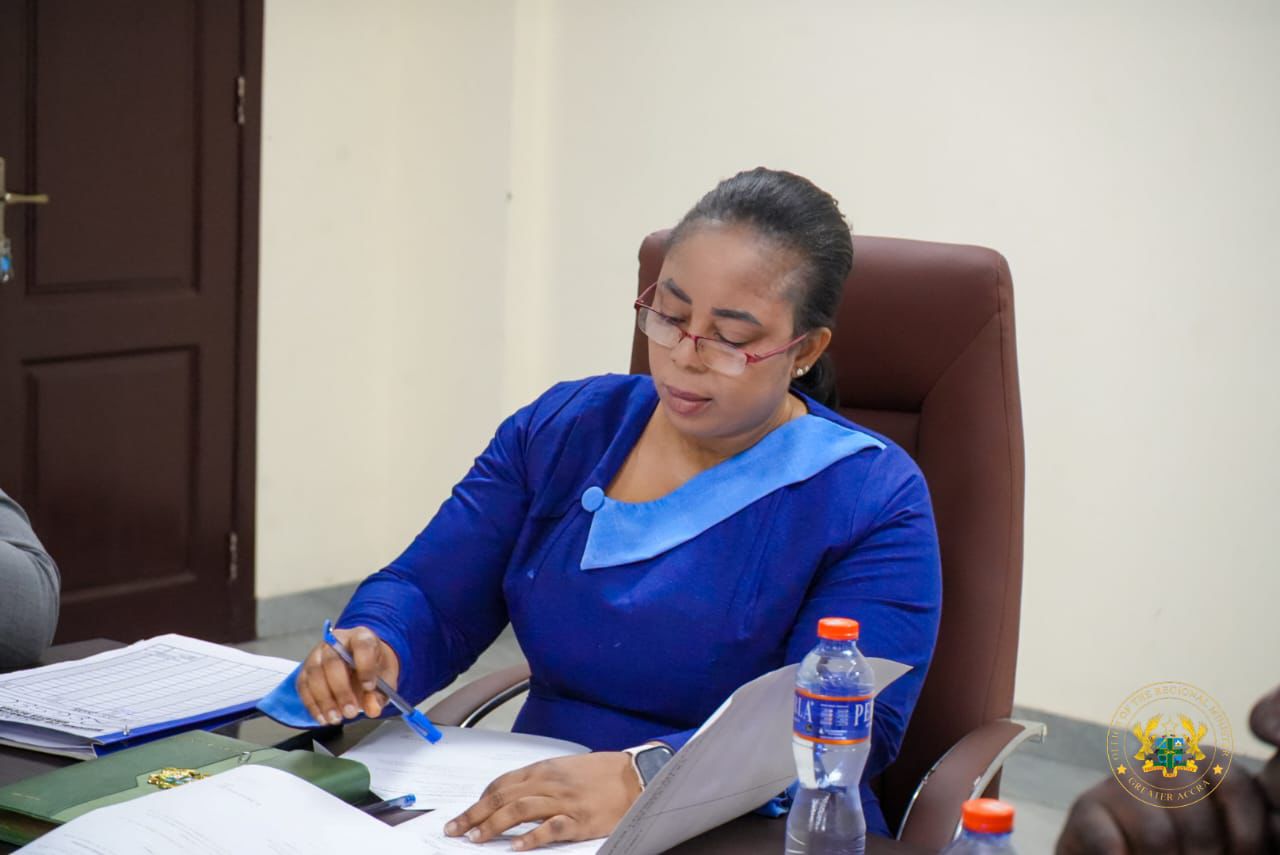
In a fierce, philosophically charged defense of state-led development against institutional gridlock, the Greater Accra Regional Minister, Hon. Linda Obenewaa Akweley Ocloo, has declared that the regional administration will not allow critical public infrastructure to be held hostage by private litigation.
The statement comes on the heels of an order issued yesterday by the Adentan High Court for substituted service regarding an alleged contempt motion against the Minister. The legal battle centers on the relocation of the Dodowa Market and the safeguarding of the historic Dodowa Forest, a massive, state-funded municipal intervention aimed at clearing choked thoroughfares and providing a modern, dignified marketplace for thousands of vulnerable traders.
Responding to the court’s order, Minister Ocloo, who is also a sitting Member of Parliament, welcomed the judicial process but firmly pointed out a breach in established constitutional protocol. Under lawful procedures, court processes involving lawmakers must be routed directly through the Office of the Speaker of Parliament.
”While that mandatory institutional procedure is yet to be fulfilled, let no one mistake administrative order for evasion,” Ocloo stated, emphasizing her unconditional belief in the sanctity of the judiciary. “When I am appropriately and legally served through the Office of the Speaker, I shall attend to it with the utmost dispatch and reverence. We will meet in the courtroom. We will bow to the gown.”
However, the Minister drew a sharp, unyielding line between personal defiance and the continuous, law-bound execution of public policy. The contempt allegations stem from an October 2025 interlocutory injunction and a subsequent April incident where the Minister intervened administratively after police arrested workers clearing the market site. Rejecting the assertion that her actions constituted contempt, Ocloo framed it as a matter of executive responsibility.
”When state-contracted workers, executing budgeted public works, are disrupted, it is the bounden duty of the Regional Minister to ensure that state apparatuses understand the national assignment underway,” she argued. “That is not contempt; that is governance. That is not lawlessness; that is the prevention of institutional paralysis.”
The dispute highlights a growing friction in Ghana between private legal technicalities and urgent national development. Ocloo cautioned that weaponizing the power of contempt to freeze public works sets a dangerous precedent for the country’s infrastructure. She noted that if every public project could be halted by the mere filing of an injunction, the nation would remain trapped in a pristine state of underdevelopment, leaving taxpayers to bear the astronomical costs of delayed contracts and idle machinery.

The Greater Accra Regional Coordinating Council (RCC) confirmed that its legal team is fully prepared to present an unassailable narrative of administrative necessity and good faith in court, confident that the bench will not allow private land disputes to paralyze the state. Urging the media to look beyond sensationalist headlines, Minister Ocloo called for a focus on the thousands of market women waiting for a safe environment to trade, promising that the mandate to develop Greater Accra will not yield to intimidation.
”The authority of the Republic is a singular garment, woven from the independent threads of the Executive, the Legislature, and the Judiciary,” Ocloo concluded, invoking a powerful constitutional metaphor. “The law was made for man, and not man for the law. We shall not choose chaos over development. The work for the people continues.”
By Raymond Ablorh