






Can a nation build its future when the tools of construction are constantly broken by the gavels of litigation? Must the collective economic survival of thousands of market women bow perpetually to the absolute, unyielding claims of a single private estate?
These are not merely academic riddles; they are the urgent, painful questions unfolding beneath the canopy of the Shai Osudoku District. As the Adentan High Court issues an order for substituted service regarding a motion for contempt against the Greater Accra Regional Minister, Hon. Linda Obenewaa Akweley Ocloo, the public is treated to a familiar, tragic spectacle.
It is a spectacle where the legitimate machinery of state development is dragged to the pillory of judicial technicality, accused of lawlessness for simply daring to serve the public good.
Let us strip this case of its dense legal foliage and look at the bare, human landscape.
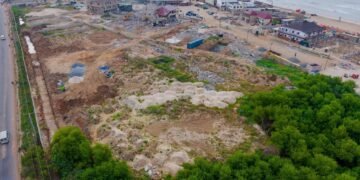
At the heart of the dispute is a parcel of land intended for two transformative public interventions: the relocation of the congested Dodowa Market and the fencing of the vulnerable Dodowa Forest.
The applicant, Bernard Oduro, brandishes an interlocutory injunction from October 2025 like a flaming sword, demanding that all state activity grind to a halt.
When state-contracted workers were arrested in April 2026, and the Regional Minister administratively intervened to clarify their national assignment, the cry of “contempt” was raised.
But whose interest is truly being condemned here? Is it the authority of the bench, or is it the fundamental right of ordinary Ghanaian citizens to dignity, safety, and development?
The law is a magnificent structure, but it was built to shelter humanity, not to cage it. Our superior courts have warned with consistent wisdom that the power of contempt must never be weaponised by private litigants to settle administrative scores or to paralyse state apparatuses.
Yet, we live in a Republic where any individual with a land receipt can stall a multi-million-cedi project, leaving taxpayers to bleed public funds through contract delays, demurrage, and abandoned infrastructure.
Consider the Dodowa Market.
It is a chaotic theatre of survival where mothers, daughters, and sisters trade under perilous conditions, spilling onto major thoroughfares, exposed to the elements and oncoming traffic.
The expansion and relocation of this market is not a commercial vanity project for the Regional Minister. She will not pocket the tolls; she will not inherit the stalls. The project belongs to the people.
It is an exercise in humanising governance, translating budgetary numbers into concrete structures where an ordinary woman can sell her wares without fear of being crushed by a runaway truck.
To equate the execution of this vital municipal duty with “wilful disobedience” is a profound misreading of executive responsibility.
A Regional Minister is not a passive spectator in her jurisdiction; she is the political head charged with ensuring urban order and public safety.

When she acts to protect the momentum of a state-funded project, she is acting under the heavy burden of public necessity.
If the executive arms of government must freeze every time an individual files a motion, governance in this country will cease entirely. No roads will be paved, no hospitals built, and the state will remain a hostage to private litigation.
The law provides adequate remedies for private grievances. If the state is found to have encroached on private land, the remedy is simple, fair, and prompt financial compensation.
The land can be valued, the money can be paid, and the individual can be made whole. But you cannot replace an unbuilt market; you cannot compensate a community for a lost opportunity to lift itself out of poverty.
When this case is called on June 24, the courts will undoubtedly demonstrate that deep, institutional understanding of the delicate balance between private rights and public progress. The law remains the ultimate arbiter, and the Regional Coordinating Council submits fully to its wisdom.
But as public opinion weighs this matter, let us remember that true justice cannot be blind to the cries of the marketplace.
The tractors in Dodowa must not sit idle. The work for the people must continue, for the true majesty of the law is found when it serves as a bridge to common prosperity, not a barrier to national development.
By Raymond Ablorh